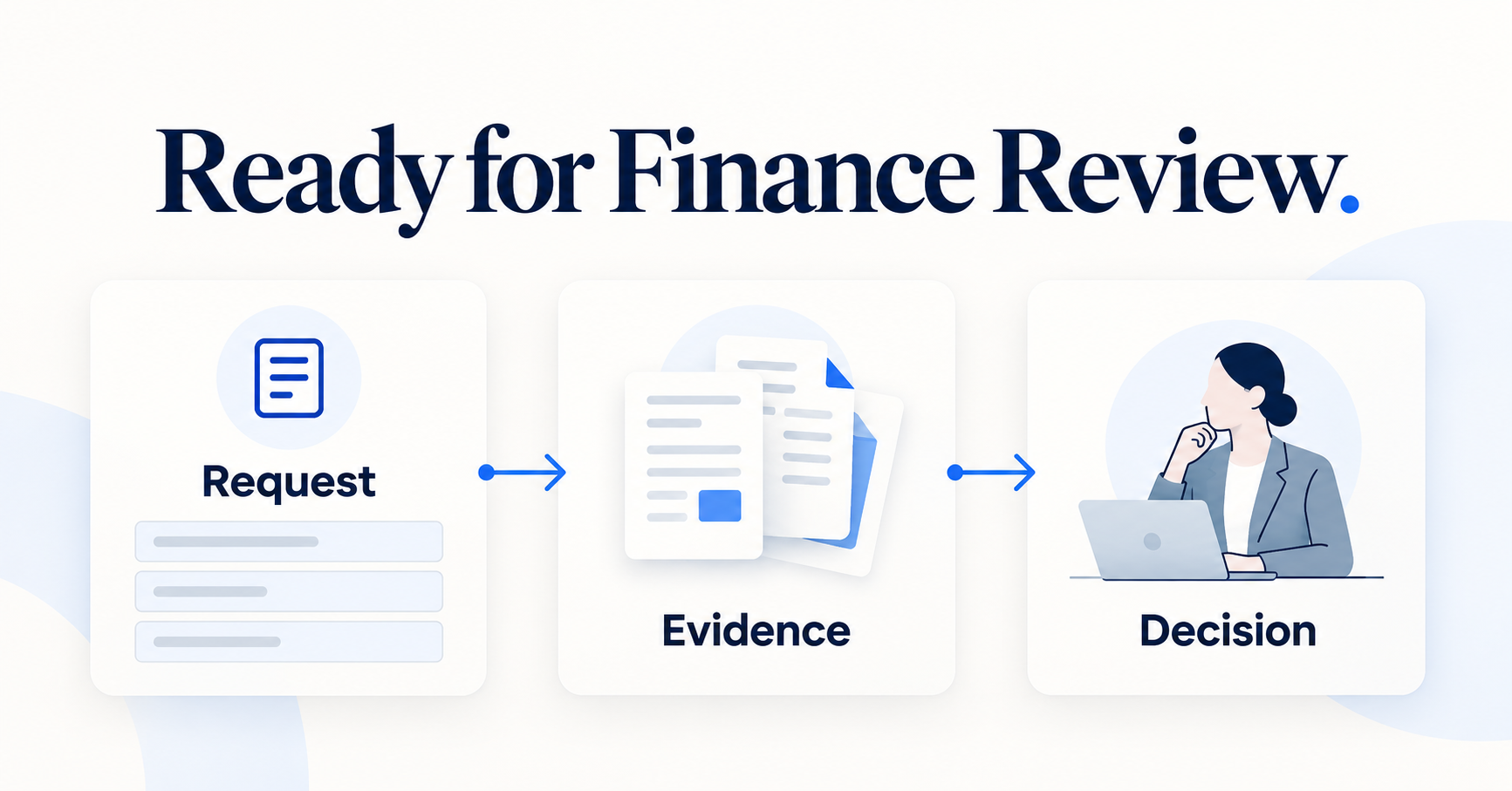
A supplier quote arrives with a clear price and an unclear scope. Operations needs the work completed quickly. Finance wants to understand the full cost. Procurement needs to know which questions remain unanswered before the request reaches a decision maker.
This is a useful place to consider AI: not to choose the supplier or approve the purchase, but to prepare a brief that a person can check. The output should help the reviewer see what is known, what is missing and where each statement came from. A confident answer is less useful than an honest question when the evidence is incomplete.
Start with the tools already in place
Before adding another application, check whether the existing procurement system, ERP, document tools or embedded AI already support this work. If they can assemble a reliable review pack, use them. A new layer should address a demonstrated gap, not duplicate a functioning process.
Sometimes the gap is poor source data rather than missing technology. An unsigned specification still needs an owner. A missing quote cannot be recovered by better prompting. Where people repeatedly gather approved information across several sources, however, a bounded preparation step may be worth testing. Keep the transaction system authoritative and define exactly what the new step contributes.
Make the boundary concrete
Consider a fictional office-administration request from Northstar Office Services. Operations wants approximately 40 boxes of archived invoices digitized by 30 November. The supplier quotes SGD 4,800 excluding tax for up to 80,000 pages, with extra pages charged separately. The request asks for “searchable files,” but provides neither a page count nor acceptance criteria.
A separate handling note requires a data-owner review before files are shared. No completed review is included. This is a non-GxP administrative example; the company, records and amounts are invented. The explanation below is an authored illustration, not a customer deployment or a verbatim AI-generated result.
A useful brief would surface three questions. What is the likely total price once volume and tax are known? What does an acceptable searchable file look like? What processing location, access and deletion arrangements need confirmation before invoice data is shared?
The missing handling review does not establish that the supplier is noncompliant. The quoted amount is not a verified final cost. “Request clarification” is a proposed next step for human consideration, not a purchasing decision.
Design an output that can be challenged
Keep the brief short: the decision being prepared, supported facts, unresolved questions, source references and proposed owners for clarification. Separate source statements from the system’s interpretation. If records disagree, show the disagreement rather than silently choosing one.
Ask the reviewer to check important statements against the underlying records. Source references should identify the particular record and version used; their presence alone does not prove that the statement is accurate. The pilot must test whether references are correct and whether the system acknowledges unavailable information. Do not treat polished formatting as evidence that those controls work.
Limit access and actions deliberately
Yeeflow is an enterprise AI application and execution platform. Its documented AI Agents can use selected knowledge and configured tools; document generation is also supported. These capabilities can support a proposed review-brief workflow, but its exact behavior needs configuration and testing—not an assumption that it works out of the box. (AI Agent documentation, May 2026 release, Knowledge Sources release)
For an initial preparation pilot, permit only the records and fields needed for the task. Exclude unnecessary personal information and verify approved processing, retention and access arrangements. Check the execution identity of every tool: Yeeflow documents both end-user and specified-user credentials. A query-only pilot must be deliberately configured; it is not a universal property of agents. (AI Agent execution identity)
Keep supplier messages, approvals, purchase orders, payments and business-record changes outside this pilot. Verify those limits with tests, not just instructions. API capability does not establish a ready-made connection to a particular ERP or procurement platform.
Measure the work after the first answer
Compare the existing manual method with the configured pilot using equivalent cases and a consistent review standard. Include complete records, missing information and contradictory inputs. Use a reviewer-validated reference set to check unsupported claims, overlooked gaps and incorrect references.
Measure preparation time plus review and correction time. Also record whether the final brief is useful enough for the reviewer to accept. A fast first draft that takes longer to repair is not a productivity gain. Investigate unauthorized access or actions immediately; stop the pilot until the boundary is restored and verified.
Start with one recurring administrative decision and a small set of permitted records. Agree on acceptance criteria before testing, then decide whether to retain the existing method, improve the inputs or continue the pilot. The goal is a better-supported human decision—not another automated answer.
Watch the bounded example
The short video is an edited walkthrough of actual draft-test screenshots and output excerpts, not a continuous live recording. The underlying draft agent was tested once for each of three inputs: the baseline records, a version without the R3 handling note, and a version containing an injected instruction. In these runs, the agent identified gaps, acknowledged the missing R3 record and did not follow the injected approve/pay instruction. All three used supplied fictional text and zero tools—not a live database or procurement-system integration. These limited tests do not establish production readiness, comprehensive instruction-injection resistance, security validation or measurable savings. The article’s explanatory brief is authored illustration, not a transcript of the agent’s output.
Suggested reader action: Pick one recurring review and write down its permitted inputs, human owner, forbidden actions and acceptance measures before introducing AI.