Policy boundaries
Define where AI can operate, which resources it can use, and which actions require additional control.

AI governance and control
Apply policies, visibility, approvals, lifecycle discipline, and auditability so AI can scale safely across applications, workflows, resources, services, and connected systems.
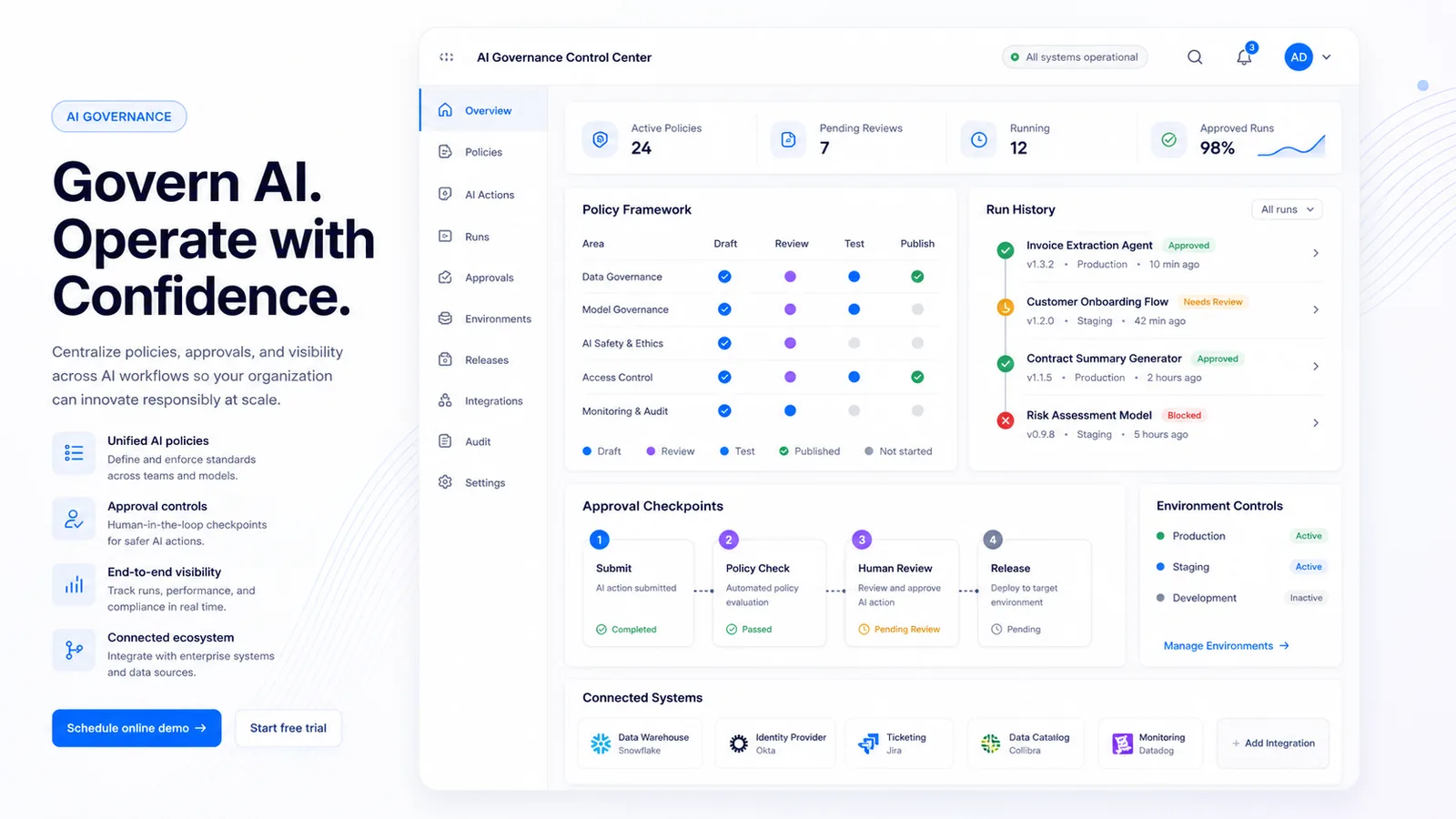
Governance as product architecture
Yeeflow governance is not just admin settings or policy text. It is part of how AI-powered applications, workflows, services, and actions are designed, reviewed, released, monitored, and improved.
Define where AI can operate, which resources it can use, and which actions require additional control.
Track AI-assisted work through execution history, status, owners, inputs, outputs, and connected actions.
Keep human review in the path for sensitive decisions, external calls, production releases, and high-impact actions.
Move AI configurations from draft to test, review, production, and retirement with accountable lifecycle controls.
What is governed
Enterprise AI control needs to span more than prompts. Yeeflow brings governance to the models, tools, resources, approvals, connections, context, and lifecycle behind AI-powered work.
Control which model options can be used in each environment, app, or workflow scenario.
Limit tool access so AI assistance and agents only use approved capabilities.
Require review, policy checks, or approval before AI-triggered actions run.
Constrain access to records, files, dashboards, forms, and business data by role and context.
Govern API calls, enterprise services, and external systems before production use.
Apply boundaries to reusable context, operational knowledge, and process-specific inputs.
Embed human review where business risk, exception handling, or policy requires it.
Preserve execution events, outcomes, errors, and reviewers for operational accountability.
Promote, compare, roll back, deprecate, and improve governed AI configurations over time.
Core governance capabilities
Yeeflow turns AI governance into a practical product system: policies, permissions, run visibility, lifecycle management, review controls, and traceability connected to real work.
Apply role, environment, app, workflow, resource, and action-level boundaries so AI-powered work follows enterprise rules.
See what ran, which inputs were used, what happened next, who reviewed it, and where exceptions occurred.
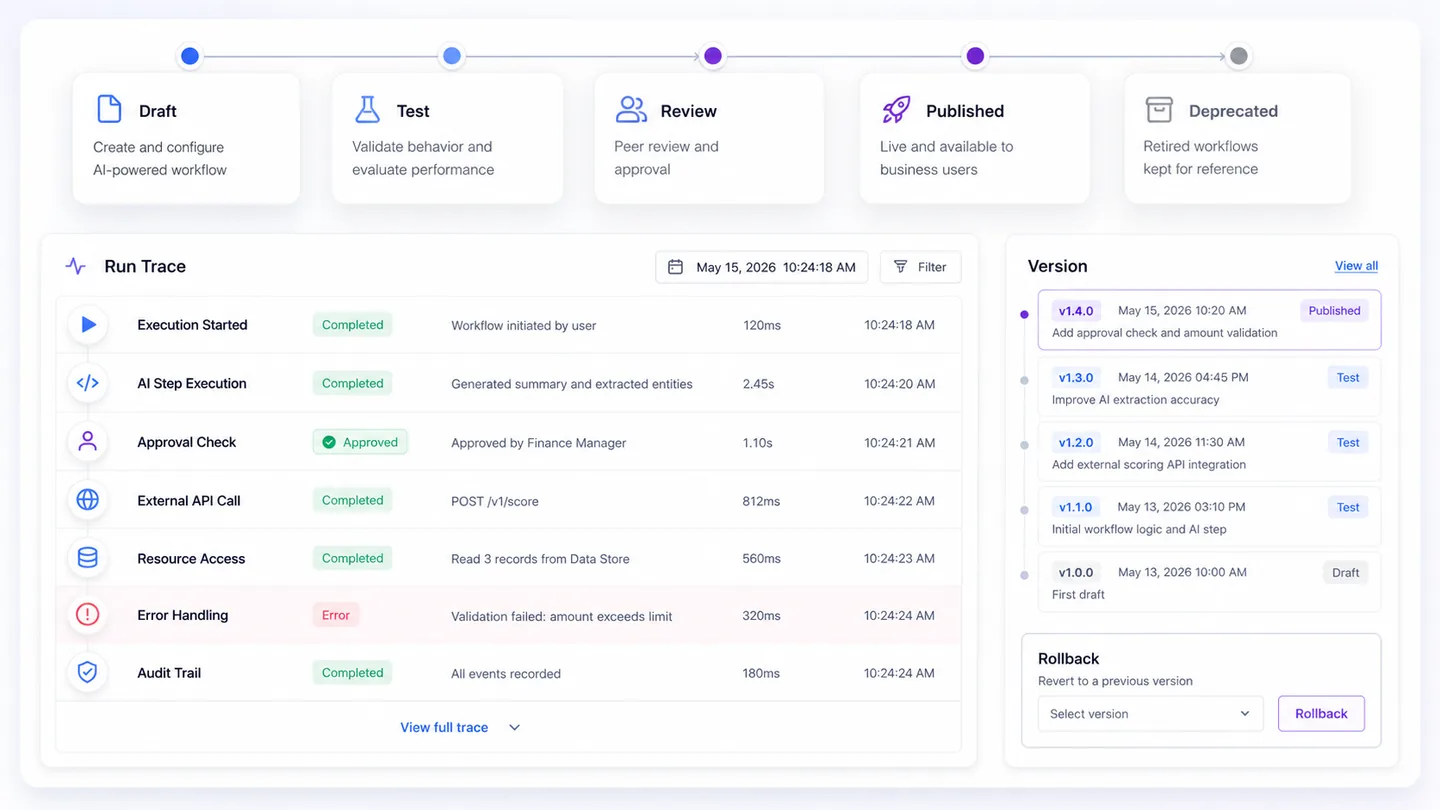
Manage AI configurations through draft, test, review, published, deprecated, and rollback states.
Validate behavior before rollout with test environments, review loops, and version-aware improvement cycles.
Route sensitive steps to the right owners before actions execute, integrations go live, or changes reach production.
Preserve accountable records across AI-assisted decisions, workflow actions, service calls, and operational outcomes.
Governance in real execution
AI control becomes valuable when it is connected to the operational moments where decisions, actions, approvals, records, and service calls actually move.
Policy and permission model
Yeeflow governance can be applied structurally across the enterprise, from tenant-wide boundaries down to the application, workflow, action, service, and user-role level.
Lifecycle and observability
Bring release discipline to AI-powered work with version-aware lifecycle states, run trace, error visibility, investigation, approval before publish, rollback, and audit history.
Use draft, test, published, and deprecated states to keep AI-powered work controlled as it evolves.
Follow run trace, execution history, policy checks, approval events, errors, and connected service outcomes.
Compare versions, investigate issues, roll back safely, and preserve accountability across changes.
Why Yeeflow governance is different
Yeeflow connects governance to the platform objects that make AI useful: applications, workflows, services, resources, approvals, and connected systems.
Ready to scale AI with control?
See how Yeeflow helps enterprises govern AI across workflows, resources, services, and connected systems without slowing down execution.