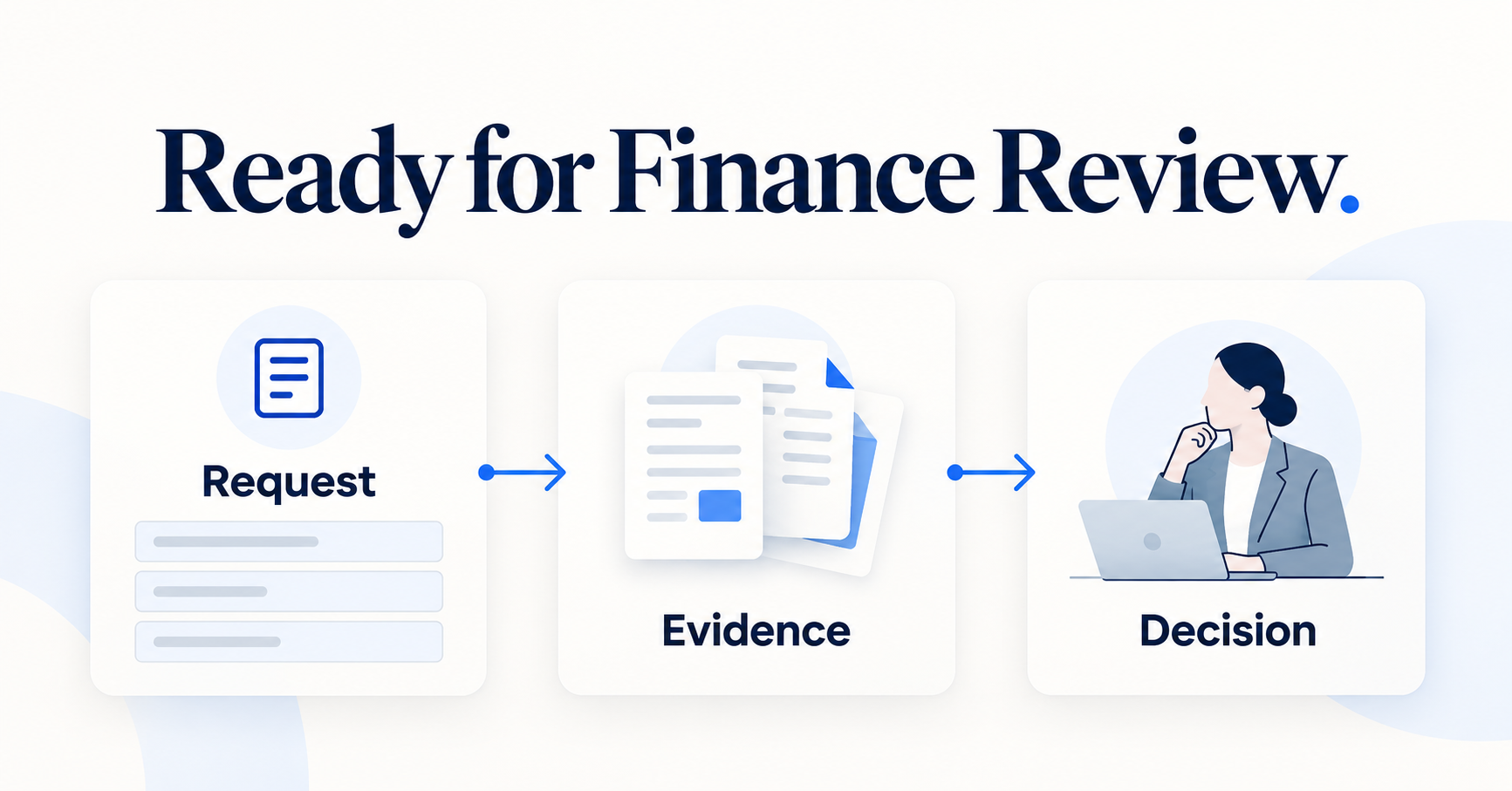
An attachment is not an approval-ready request
A finance reviewer opens a new request. There is an invoice attached, a short explanation and a message asking for urgent approval. But which business entity is responsible? Does the amount match the supporting document? Who can confirm that the goods or services were received?
The request exists. The decision cannot yet be made.
This is a useful place to improve a finance process: before an approver is asked to approve anything. An intake checklist defines what a reviewer needs, who supplies it and what happens when it is missing. It does not replace financial judgment. It makes the evidence available for that judgment.
For a regional shared-services team, the checklist also creates a common starting point across locations. Local requirements can remain different without leaving every requester to guess what finance needs.
Separate readiness from authorization
Treat three questions as separate decisions:
- Is the request complete enough to review?
- Is the requested action authorized under the organization's policy?
- Has the authorized action actually been completed?
A complete request can still be rejected. An approved request can still be awaiting a downstream action. A payment request should not be labelled paid simply because an approval step is finished.
Give intake readiness its own definition. For example: the request has an accountable owner, the relevant entity and transaction details, the evidence required for its type, and an explanation of any declared exception. That is an operating definition to agree with your finance team, not a universal accounting standard.
Avoid combining everything into a single “done” status. Requesters need to know whether they owe information, whether finance is reviewing it or whether another team owns the next step.
Build a five-part readiness checklist
Start with one request type, such as a vendor invoice review. The following illustrative checklist uses no real supplier or payment data. Adapt it to your own policy and system of record.
- Purpose and ownership. Record what decision is requested, who submitted it and who can answer follow-up questions. The requester supplies the information; the intake owner checks that the purpose is understandable. If someone submits on behalf of a colleague, name the business owner as well.
- Entity and allocation. Capture the responsible business entity and the cost allocation reference required by your organization. The business owner confirms the allocation. If it is unknown, return a specific question rather than choosing a likely value.
- Amount and currency. Record both, with a clear basis for any differences between the request and supporting document. The requester supplies the figures; the designated reviewer checks consistency. An unexplained mismatch is an exception to resolve, not a formatting problem to hide.
- References and evidence. Include the invoice or other source document and the relevant order, contract or receipt reference where policy requires it. The evidence owner supplies missing material. A file being present does not establish that it is correct or sufficient.
- Timing and exceptions. State the required date, the business reason and any departure from the normal process. The process owner determines the next review path. A requester-selected urgency label does not grant approval authority.

For each item, define what counts as acceptable evidence. “Attach supporting documents” is too vague if reviewers consistently need a particular record. Equally, do not require every document for every request just because the form can collect it.
Ask different questions for different requests
Travel reimbursement, capital expenditure and vendor invoice review should not share an identical evidence checklist. They may share basic fields, but the decisions are different.
A reimbursement request might need a business purpose and the evidence specified by the expense policy. A capital expenditure request might need the sponsor's rationale and the information required by the investment approval process. An invoice review might depend on a purchase reference and confirmation from a receiving team.
Write these requirements in plain language before configuring the application. Ask a reviewer to explain why each field is needed and who can reasonably provide it. Remove questions that nobody uses. If a field is required only in a specific situation, make that condition explicit in the design.
Also define what must not be collected in the intake record. Avoid copying banking credentials or unnecessary personal data into general attachments. Use your organization's approved channels and access controls for sensitive information.
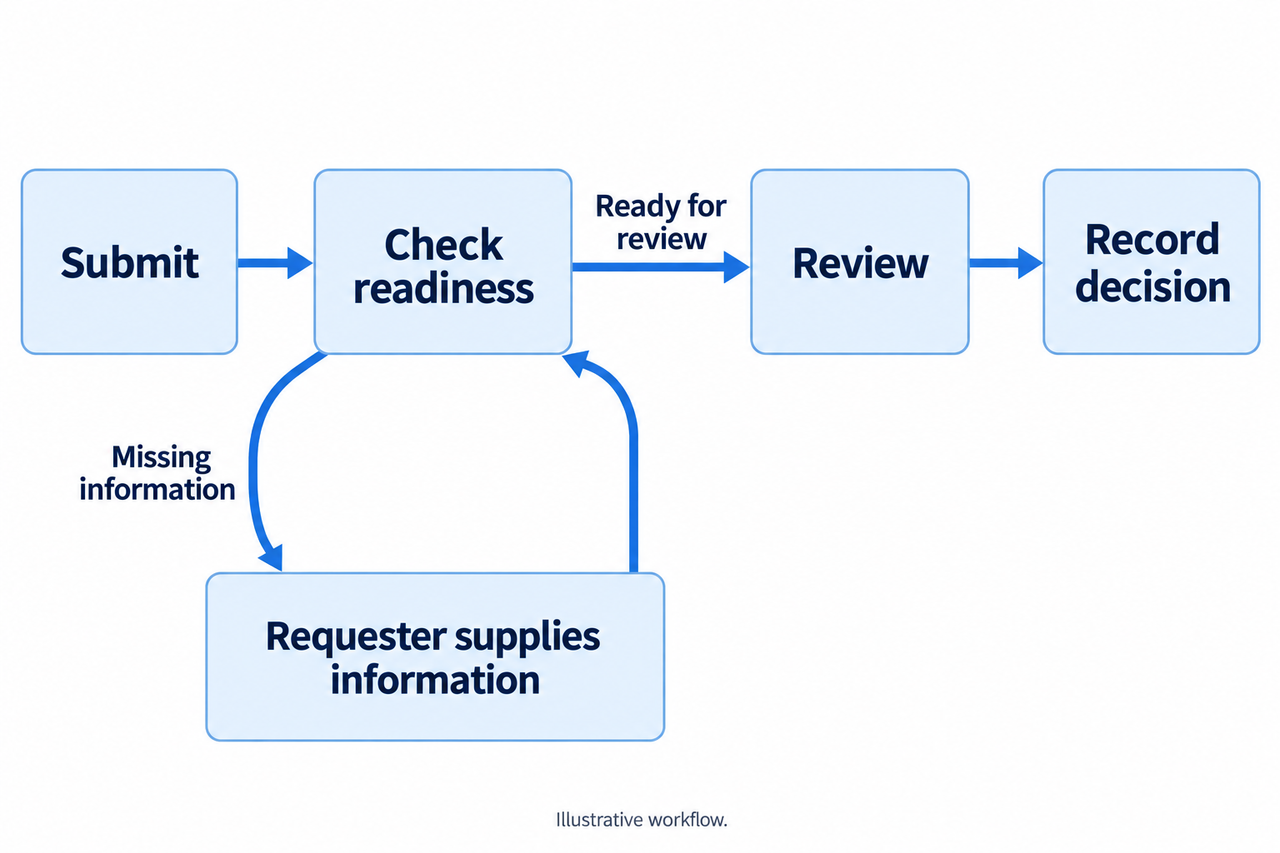
Design the return-for-information loop
An incomplete request needs a useful next action, not simply a rejection label.
A return message should identify the missing item, explain what would satisfy the requirement and name the person responsible for supplying it. Where a date matters, record the agreed response date rather than inventing a service commitment.
For example: “Please add the receiving team's confirmation for this invoice. The attached purchase order identifies the order, but does not confirm receipt. The requesting department owns this update.”
Keep the clarification linked to the request. Define whether resubmission continues the existing review or starts a new one. If a request's amount, entity or underlying scope changes, decide which checks must be repeated. The organization should set that rule before people rely on the workflow.
An intake owner should also handle requests that have no clear evidence owner. Otherwise, the form merely moves an unresolved responsibility from email into a queue.
Preserve the basis for the decision
A reviewer needs to know which information supported the decision. Establish a way to retain the relevant request details, document references, clarification history and decision rationale under your retention policy.
Do not assume that keeping the latest attachment is the same as preserving the reviewed evidence. Document storage, version handling and access permissions depend on the chosen configuration and connected systems. Test what happens when a requester replaces a file after review or when a source document becomes inaccessible.
The same principle applies to integration failures. If an approved request must be passed to another system, define who sees a failed handoff and who resolves it. Approval and successful downstream processing are separate facts.
Measure readiness, not just submission volume
Use a small pilot to establish a baseline. First-pass completeness can be defined as the number of submitted requests that meet the agreed intake criteria without clarification, divided by all requests assessed for intake readiness in the same period.
Keep the request type and assessment rules consistent. Record the most common missing items and the number of clarification cycles. Separate time waiting for requester information from time spent in finance review so that the metric points to an actionable issue.
Do not reward a higher completeness rate if it comes from making requests harder to submit or marking incomplete requests as ready. Review a sample of the underlying records with the people doing the work.
Turn the checklist into a configured application
Yeeflow is an enterprise AI application and execution platform. Its finance solution brings configurable workflows, approvals, structured operational data and reporting together. Use that foundation to discuss how your intake fields, ownership rules and review steps should work together.
The checklist in this article is a solution-design pattern, not a preinstalled finance control or a promise that documents are automatically verified. Connections to document repositories, accounting systems or payment processes require their own configuration and testing.
Begin with one request type and walk a complete example, an incomplete example and an exception through the proposed process. If everyone can identify the next owner and the evidence needed at each step, you have a clearer basis for implementation.
Bring one finance request type and its supporting-document checklist to the Yeeflow team.