Why API Authentication Is More Than Just Security
Modern enterprises no longer operate with isolated applications.
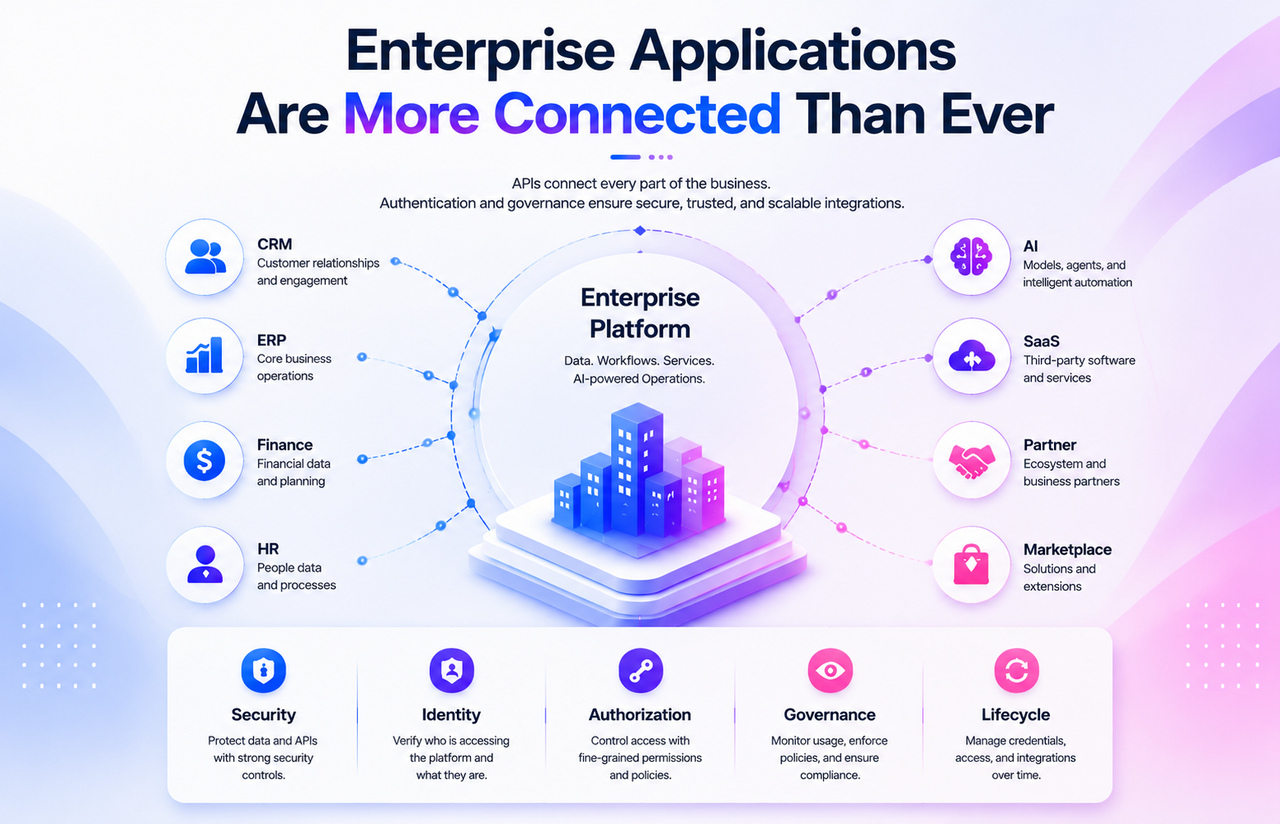
Customer relationship management (CRM), enterprise resource planning (ERP), HR systems, finance platforms, AI services, and third-party SaaS applications are increasingly connected to automate business processes and enable seamless data exchange. A single workflow may retrieve customer information from a CRM system, validate budgets in an ERP platform, invoke an AI service to analyze a contract, and automatically update records across multiple business applications.
At the same time, organizations are opening their platforms to partners, customers, developers, and AI-powered applications that need secure access to enterprise data and services.
APIs make all of this possible.
However, exposing an API is only the beginning. As more systems, applications, AI Agents, and users interact with an enterprise platform, organizations must answer a much broader set of questions:
- Who is accessing the platform?
- Which resources are they allowed to access?
- How are permissions granted, updated, or revoked?
- How can administrators manage hundreds or even thousands of connected applications securely?
API authentication is no longer just a technical implementation detail. It has become a fundamental part of enterprise platform governance, security, and scalability.
Today, the two most widely adopted authentication approaches are API Keys and OAuth. While both are designed to protect APIs, they solve different problems and are intended for different integration scenarios.
Understanding when to use each approach is an important step toward building a modern enterprise integration platform.
API Keys vs OAuth: The Same Goal, Different Approaches
Developers often compare API Keys with OAuth and assume that OAuth is simply a newer or more advanced version of API Key authentication.
In reality, they are designed with different philosophies.
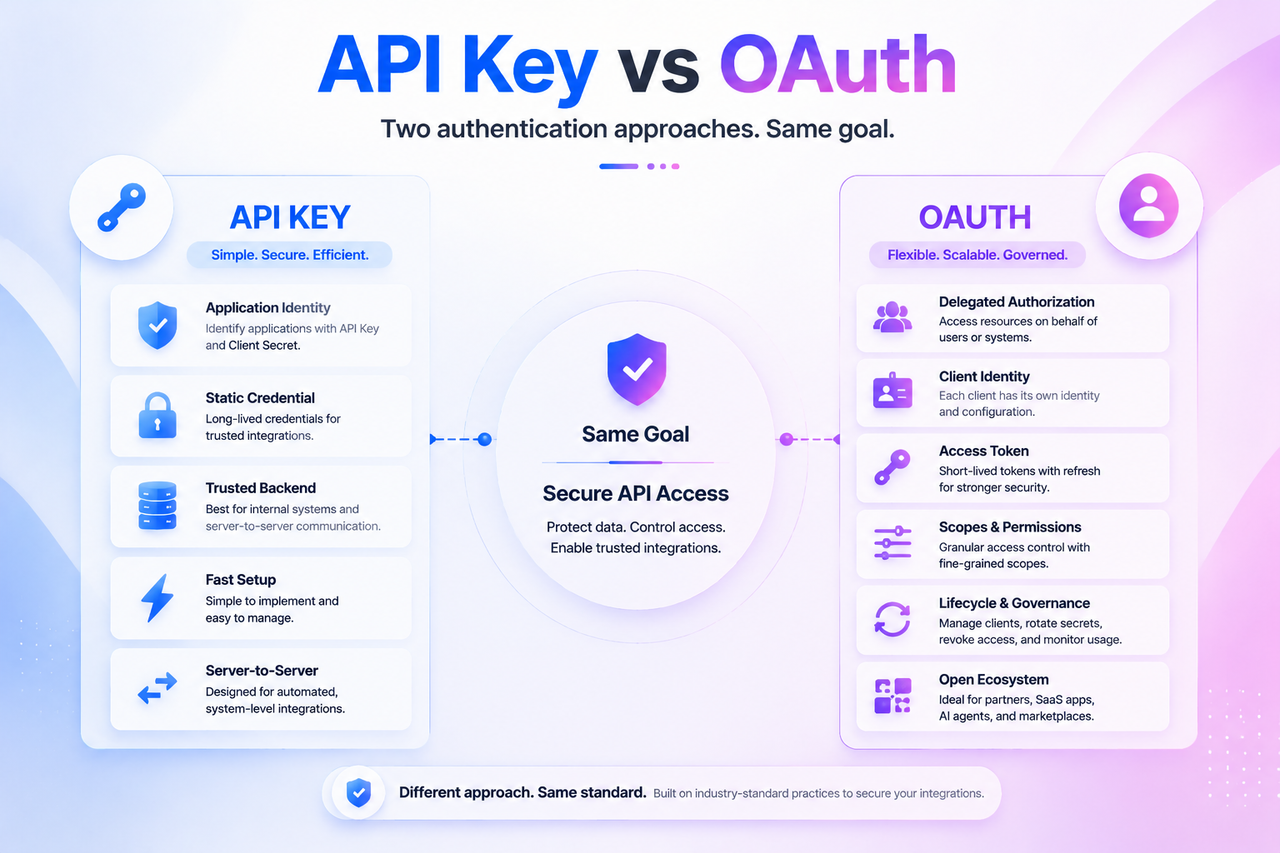
Both API Keys and OAuth share the same objective: allow trusted applications to securely access protected APIs. The difference lies in how identity is established, permissions are granted, and access is managed over time.
API Keys: Simple and Efficient Application Authentication
An API Key is the simplest way to authenticate an application.
The platform generates a unique credential for a client application, which includes the credential in every API request. The server validates the credential before processing the request.
This model is lightweight, easy to implement, and requires minimal development effort.
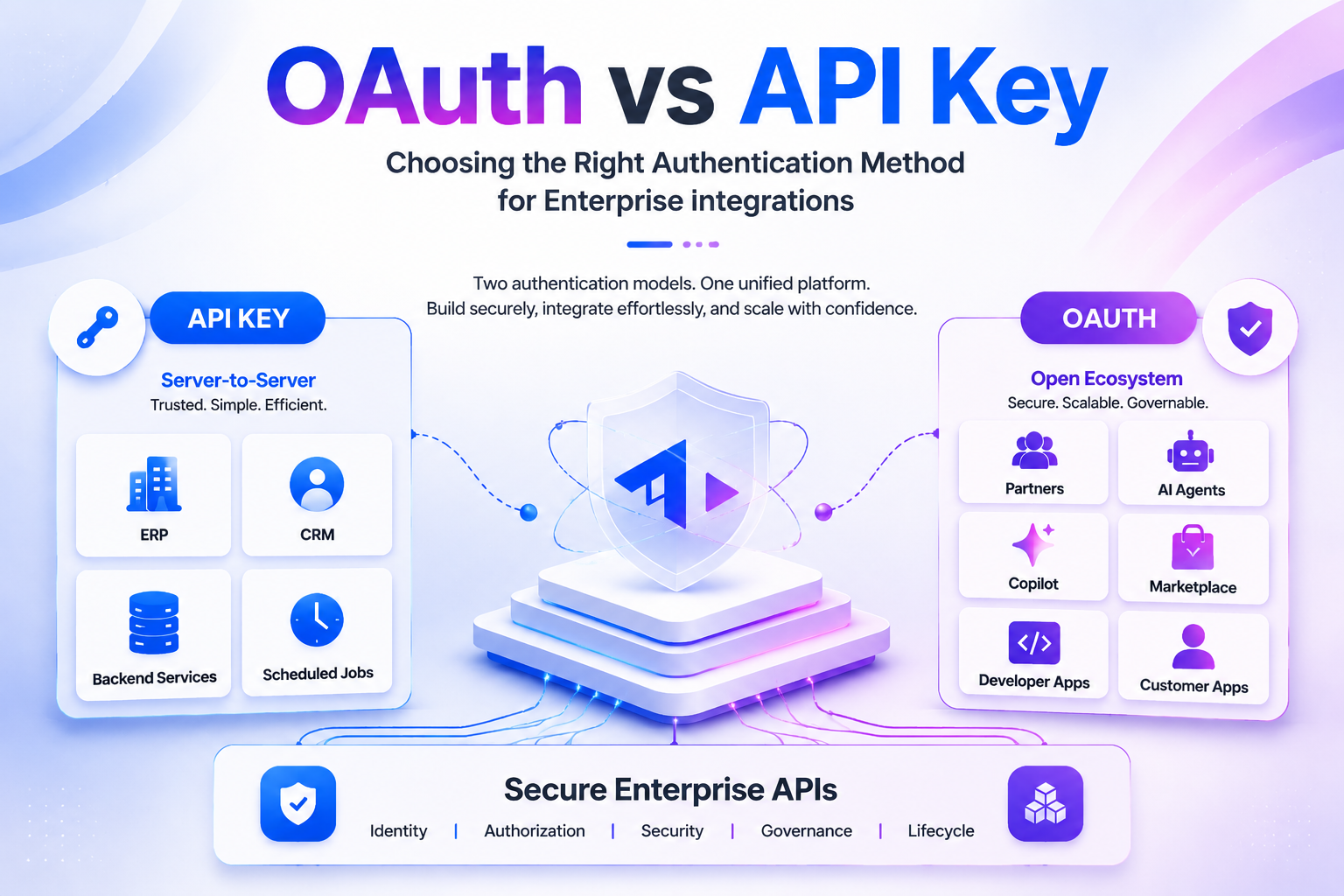
It is particularly well suited for trusted server-to-server integrations where the calling application has a fixed identity, such as:
- ERP systems
- CRM platforms
- Financial applications
- Internal automation services
- Scheduled synchronization jobs
- Backend integration services
In these scenarios, the application itself represents the identity. There is typically no need for end-user authorization or complex permission delegation. As long as the credentials are securely managed, API Key authentication provides a reliable and efficient solution.
For this reason, API Keys continue to be one of the most common authentication methods for enterprise backend integrations.
OAuth: Authentication, Authorization, and Lifecycle Management
OAuth takes a fundamentally different approach.
Rather than allowing applications to access APIs using long-lived credentials, OAuth separates client authentication from resource authorization.
Before an application can call a protected API, it must first authenticate itself—or obtain authorization from the user—through an authorization server. Once the request is approved, the authorization server issues an Access Token, which the application then uses to access protected resources.
To support this process, OAuth defines a standardized authorization framework built around several key components.
Every application is registered as an OAuth client and receives a unique Client ID that identifies the application. Confidential applications also use a Client Secret to authenticate themselves securely. Administrators can define Scopes to specify exactly which resources an application is allowed to access, enabling fine-grained permission control instead of granting unrestricted API access.
When user authorization is involved, OAuth uses a registered Redirect URI to safely return authorization results to the client application. Public clients, such as mobile and single-page web applications, can further improve security by using PKCE (Proof Key for Code Exchange) to protect the authorization flow against interception attacks.
Unlike API Keys, OAuth credentials are not intended to remain static. Access Tokens, Refresh Tokens, Client Secrets, and other credentials all have defined lifecycles and can be rotated, renewed, or revoked according to an organization's security policies.
As a result, OAuth provides far more than authentication. It offers a comprehensive framework for identity management, authorization, and long-term governance.
This is why major technology platforms—including Microsoft, Google, GitHub, Salesforce, and countless SaaS providers—have adopted OAuth as the industry standard for secure API access.
Why More Enterprises Are Choosing OAuth
API Key authentication remains an excellent choice for many enterprise integrations.
If an organization only needs to synchronize data between trusted internal systems—for example, automatically creating workflows from an ERP system, synchronizing customer records from a CRM platform, or running scheduled background services—API Keys often provide the simplest and most efficient solution.
These systems typically operate within trusted environments, have predictable communication patterns, and do not require user-specific authorization.
As organizations continue their digital transformation, however, integration requirements become more complex.
Enterprise platforms increasingly need to support:
- Business partners
- Third-party SaaS applications
- AI Agents
- AI Copilots
- Marketplace applications
- Customer-developed applications
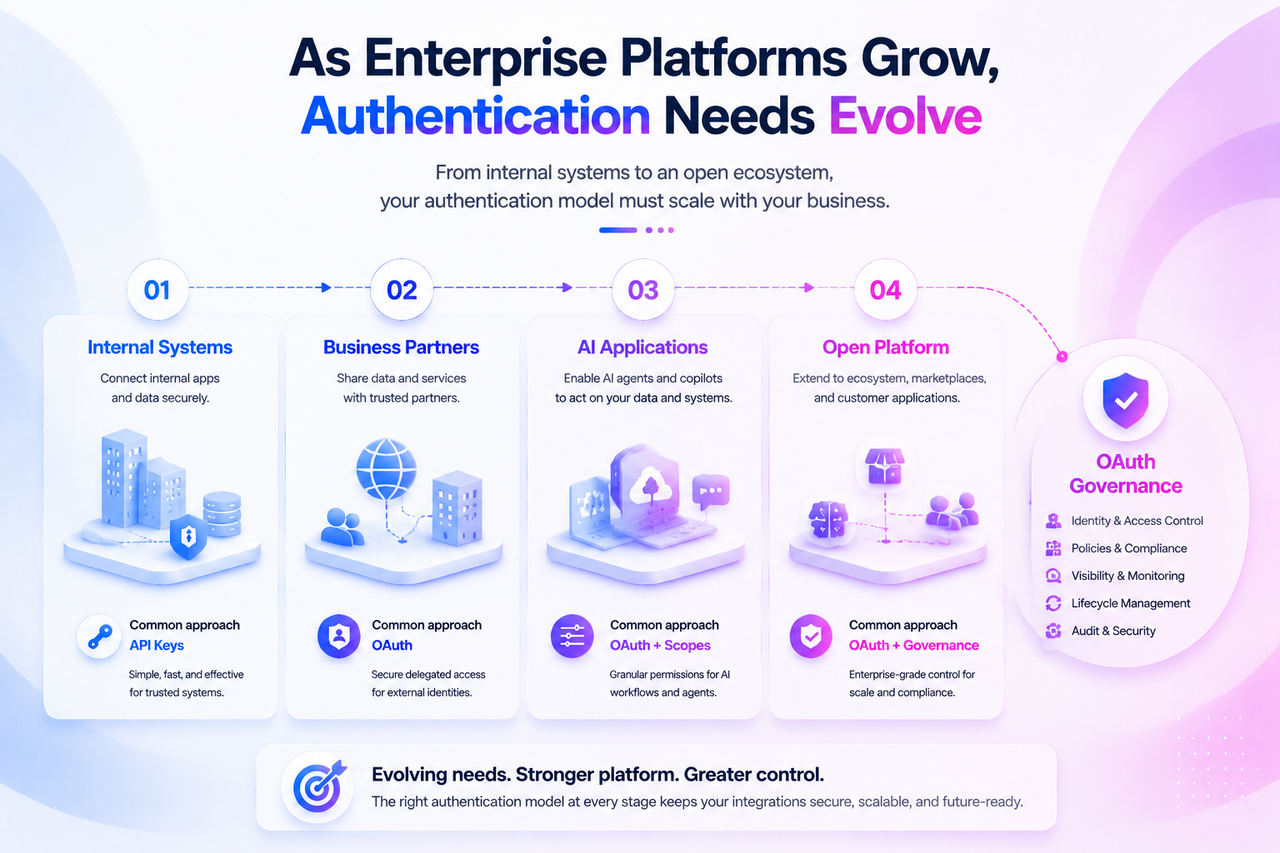
Instead of managing a handful of trusted backend services, organizations may need to manage hundreds of independent client applications, each with different permissions, security requirements, and authorization lifecycles.
Administrators need visibility into which applications have access to the platform, what resources they can use, and how those permissions can be modified or revoked over time.
These requirements extend far beyond what traditional API Key authentication was designed to address.
OAuth was created specifically for these scenarios.
Rather than simply verifying whether an application can access an API, OAuth establishes a structured framework for managing client identities, delegated permissions, authorization policies, and credential lifecycles—allowing organizations to build open ecosystems without sacrificing governance or security.
That does not mean OAuth replaces API Keys.
For trusted backend integrations, API Keys remain a simple, efficient, and highly practical solution. OAuth becomes the preferred choice when organizations need to support external developers, partners, AI-powered applications, or user-authorized access at scale.
The question is not which technology is more advanced.
The real question is which approach best matches your business requirements today—and can continue to support your platform as it grows.
How Yeeflow Supports Both API Keys and OAuth
In the real world, there is no single authentication method that fits every integration scenario.
Some organizations simply need to connect trusted internal systems such as ERP, CRM, or finance platforms to automate business processes. Others are building open platforms that allow partners, customers, third-party SaaS applications, AI Agents, Copilots, or Marketplace applications to securely connect to enterprise services.
These two scenarios have very different requirements.
One prioritizes simplicity, reliability, and efficient server-to-server communication. The other requires centralized client management, delegated authorization, granular permissions, and long-term governance.
Instead of forcing organizations to choose one authentication model for every situation, Yeeflow supports both.
Through App Credentials and OAuth Integrations, Yeeflow enables organizations to adopt the authentication model that best fits each business scenario while maintaining a consistent and secure integration experience across the platform.
Although both capabilities are designed to protect API access, they serve different purposes.
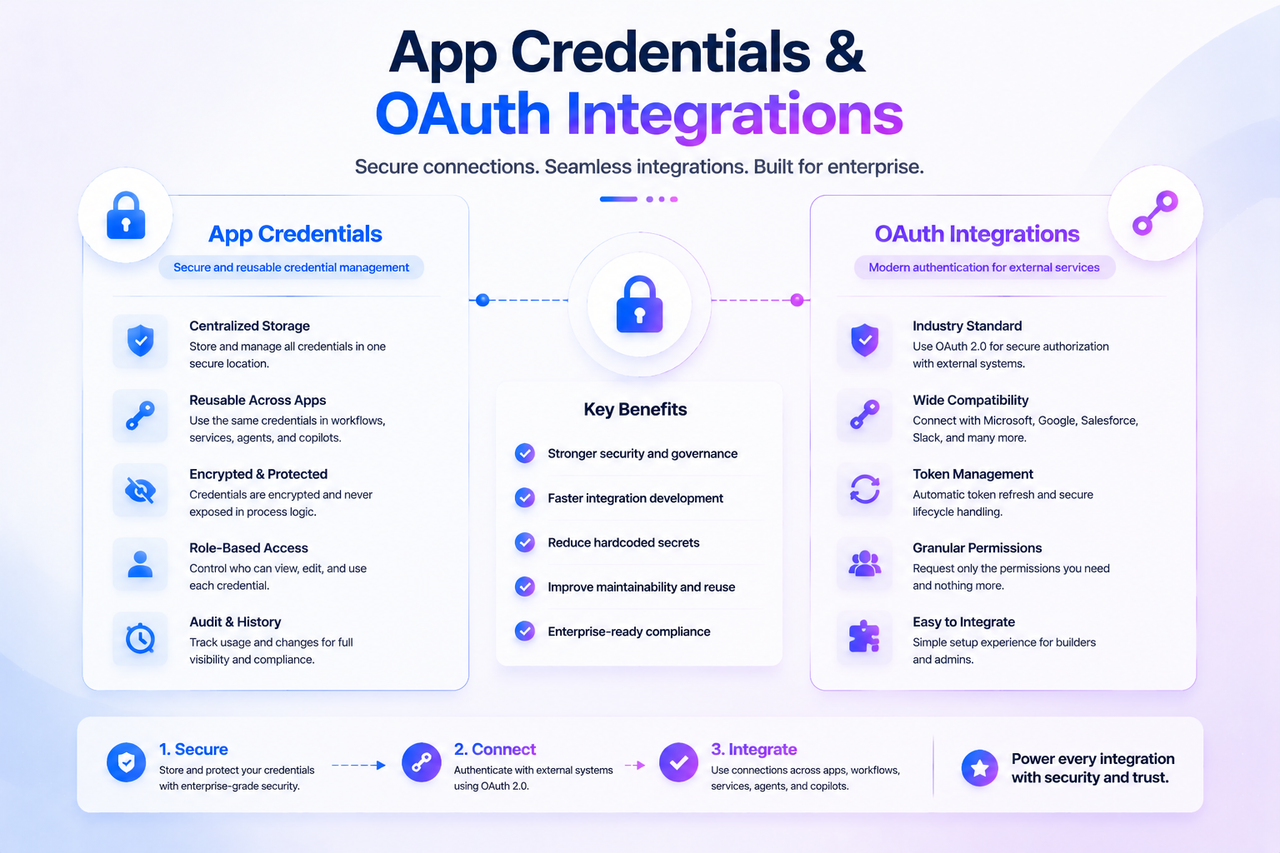
App Credentials provide application-level authentication for trusted integrations based on the API Key model, while OAuth Integrations provide platform-level OAuth client management for building secure and scalable integration ecosystems.
Together, they enable organizations to evolve from internal system integration to enterprise-scale platform connectivity without changing platforms or redesigning their integration architecture.
App Credentials vs OAuth Integrations: What's the Difference?
For many organizations, backend system integration remains the most common use case.
ERP systems need to synchronize purchasing data. CRM platforms need to update customer information automatically. Integration services need to create workflows or retrieve business records from Yeeflow without requiring user interaction.
For these scenarios, Yeeflow provides App Credentials.
App Credentials use an API Key-based authentication model to establish trusted application identities. Each application receives its own credentials, allowing it to securely communicate with Yeeflow APIs without implementing the full OAuth authorization process.
Administrators can configure which platform resources the application can access—including Data Lists, Forms, Workflows, and Custom Services—and manage credential lifecycles through features such as Client Secret management, expiration policies, secret rotation, and credential activation or deactivation.
The result is a straightforward integration experience that minimizes development effort while providing the level of security required for trusted backend systems.
As organizations expand beyond internal integrations, however, their requirements begin to change.
Modern enterprise platforms often need to support dozens—or even hundreds—of external client applications. Business partners, third-party SaaS vendors, AI Agents, Copilots, and customer-developed applications all require secure, independently managed access to enterprise resources.
This is where OAuth Integrations become essential.
OAuth Integrations provide centralized management for OAuth clients across the Yeeflow platform. Each client application is registered with its own Client ID, Client Secret, Redirect URI, authorization configuration, and permission scopes.
Depending on the integration scenario, organizations can choose from three authorization models:
- User Authorization — allowing applications to access resources on behalf of authenticated users.
- System-to-System Authorization — enabling trusted backend services to communicate without user interaction.
- Both — supporting applications that require both user-delegated and server-to-server access.
Beyond authentication itself, OAuth Integrations provide centralized governance throughout the entire authorization lifecycle. Administrators can manage client registrations, rotate credentials, control authorization scopes, monitor integrations, and revoke access whenever necessary.
This level of governance becomes increasingly important as enterprise ecosystems continue to grow.
In simple terms:
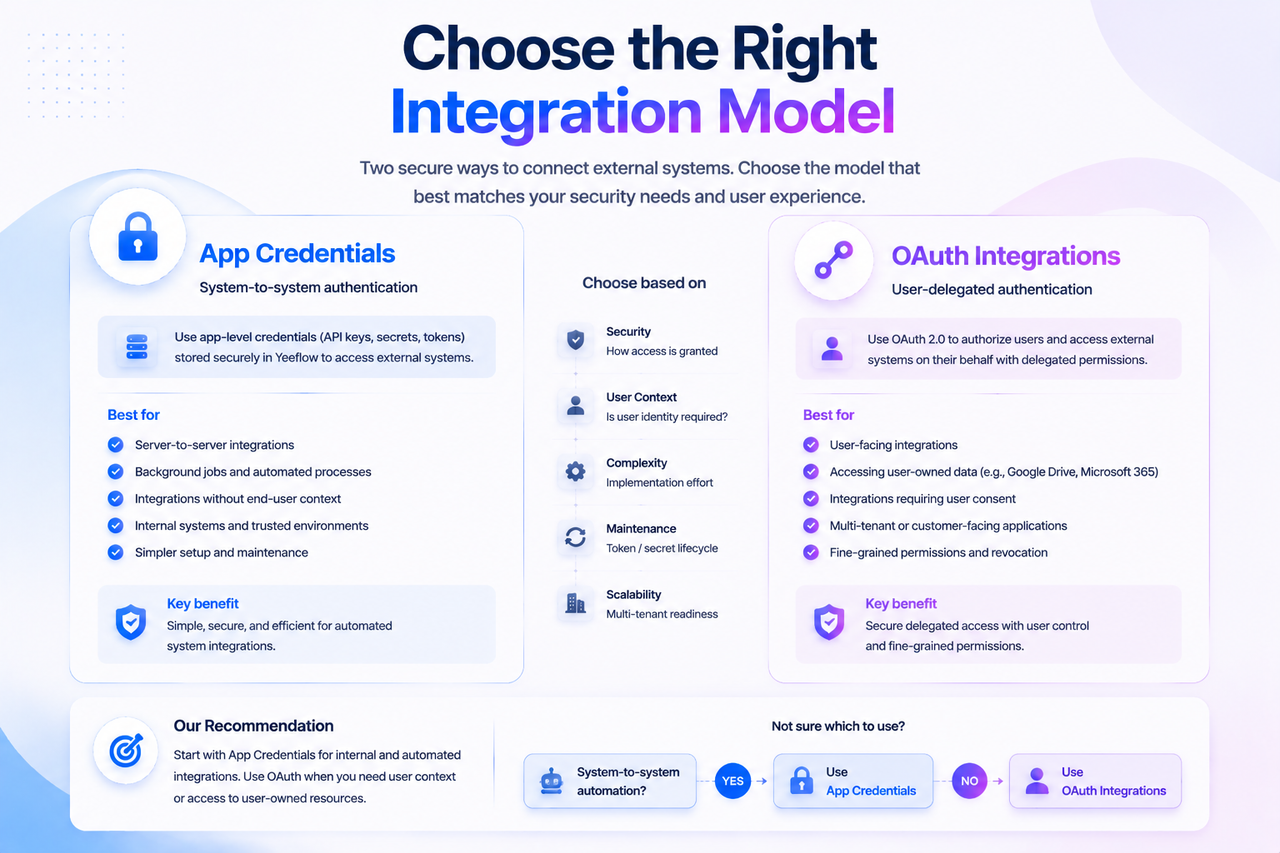
- App Credentials focus on securely connecting trusted applications.
- OAuth Integrations focus on securely managing an open integration platform.
Rather than replacing one another, the two capabilities complement each other by supporting different stages of an organization's integration journey.
How to Choose Between App Credentials and OAuth Integrations
After understanding the differences between API Keys and OAuth, the next question becomes:
When should you use App Credentials, and when should you choose OAuth Integrations?
The answer depends less on the technology itself and more on the business scenario you're trying to support.
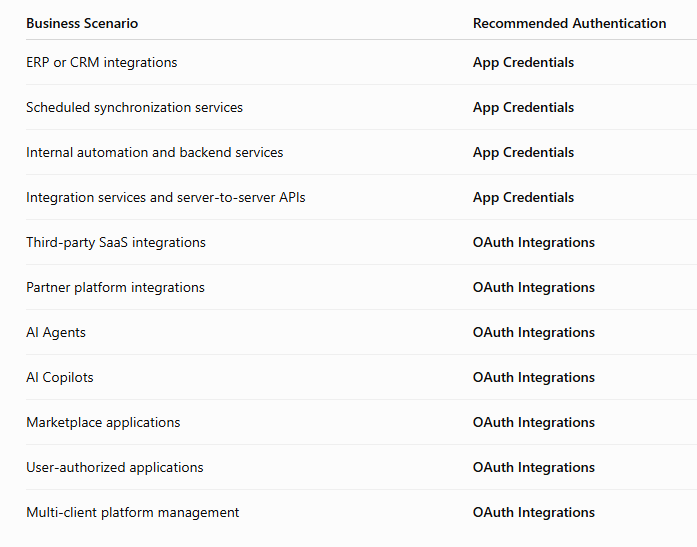
If you're integrating trusted backend systems with fixed identities, App Credentials are often the simplest and most efficient option.
For example, an ERP system that synchronizes purchase orders every night, a CRM platform that automatically updates customer records, or an internal integration service that creates workflows in Yeeflow all operate within controlled environments. These applications do not require user authorization, nor do they need complex client registration or delegated permissions.
In these cases, App Credentials provide everything needed for secure, reliable API communication while keeping implementation straightforward.
OAuth Integrations become the better choice when organizations are building an open platform.
If your APIs need to be accessed by partners, independent software vendors, AI Agents, Copilots, customer-developed applications, or Marketplace solutions, managing access through individual API Keys quickly becomes difficult to scale.
OAuth Integrations allow every client application to have its own identity, its own authorization policies, and its own permission boundaries. Administrators can control exactly what each application is allowed to access, manage authorization lifecycles centrally, and maintain governance as the ecosystem grows.
The choice can be summarized as follows:
For many organizations, this is not an either-or decision.
Enterprise integration often evolves over time.
Organizations typically begin by connecting internal systems using App Credentials. As their platforms mature and become more open to external developers, partners, and AI-powered applications, OAuth Integrations provide the governance, scalability, and flexibility required to support the next stage of growth.
Conclusion: Build for Today, Scale for Tomorrow
API Keys and OAuth are not competing technologies—they are complementary approaches to enterprise API authentication.
For trusted backend integrations, App Credentials offer a simple, efficient, and secure way to connect enterprise systems with minimal implementation complexity.
For organizations building open platforms, OAuth Integrations provide comprehensive client management, delegated authorization, permission control, and lifecycle governance that support long-term scalability.
As AI becomes increasingly embedded in enterprise applications and business processes, APIs are evolving beyond simple system interfaces. They are becoming the foundation that connects workflows, business applications, AI services, partners, and developers into a unified digital ecosystem.
By supporting both App Credentials and OAuth Integrations, Yeeflow enables organizations to meet today's integration requirements while preparing for tomorrow's enterprise platforms.
Whether you're connecting trusted internal systems, enabling secure AI-powered automation, or building an open ecosystem for partners and developers, Yeeflow provides the flexibility, security, and governance needed to build enterprise integrations with confidence.