An AI workflow can process a document in seconds. The business may still have work to do.
An invoice may need a purchase-order match. A service request may be missing information. A recommendation may need review before someone can act on it.
These steps matter when evaluating whether AI is making operations more efficient. A low model bill tells you about technology consumption. It does not tell you the full cost of getting useful work finished.
For an operational pilot, start with a question the business can recognize: What does it cost to complete one request to an agreed standard?
This outcome-based approach is consistent with the FinOps Foundation’s unit economics guidance, which connects technology spending to business value and encourages comparisons across cost, speed, quality and risk.
Define what “completed” means
The useful unit is usually a business outcome, not an AI interaction.
For an invoice workflow, extracting the supplier name and amount is one technical step. The business outcome might be an invoice that has passed the required checks and reached an approved, payment-ready status. That is not the same as paying the invoice. Choose the boundary deliberately.
For other processes, the unit might be a service case resolved, an employee onboarding request completed, or a purchase request approved and handed over for ordering.
Write down the acceptance conditions before collecting results:
- Which checks must pass?
- Who can accept the outcome?
- What evidence confirms completion?
- How will you handle requests that are reopened?
Count distinct requests, not individual model calls, retries or repeated approvals. If a request is reopened, keep its additional effort attached to the same record and apply a documented rule for its completion status.
Keep the definition stable during the comparison. Otherwise, a lower cost may simply mean that less work is included.
Keep two cost views
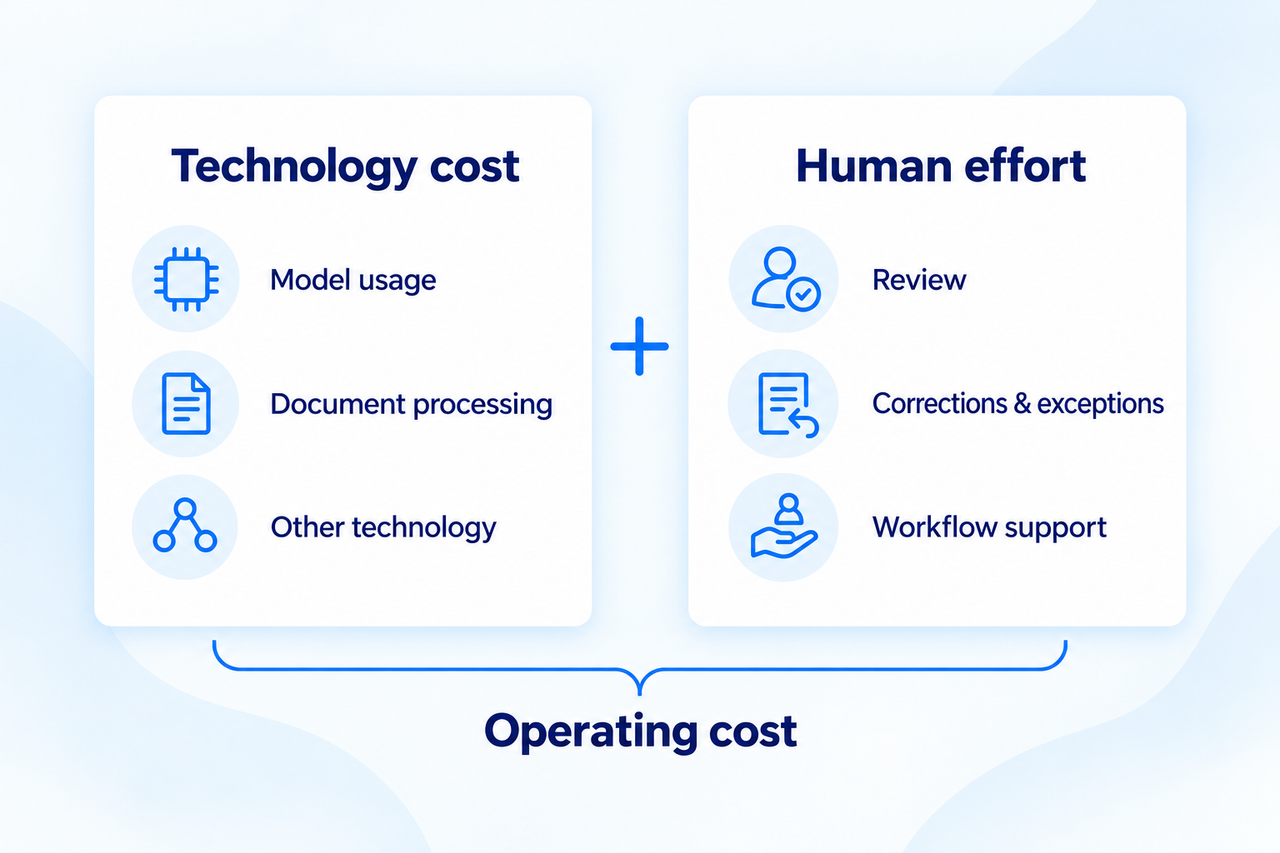
Separate technology cost from the wider operating cost.
Technology cost may include model usage, document processing, integration services, storage and an allocated share of relevant platform subscriptions.
Operating cost adds human time spent reviewing, correcting, resolving exceptions and supporting the workflow.
Keep both views visible. A model change might reduce technology spending but increase review effort. Better input validation might do the opposite.
Shared costs need a stated allocation method. A platform subscription serving several processes should not automatically be charged entirely to one pilot. Avoid counting the same charge twice when costs appear in both a provider bill and a platform allocation.
Record implementation and training costs separately. Include them in the broader business case, but do not bury a one-time setup expense inside a weekly operating figure without explaining it. If you spread that expense over an expected period or volume, show the assumption.
Match the costs to the requests
For a first pilot, a defined group of requests makes the calculation easier to interpret. For example, track all invoices received during a selected week, then assess that same group at an agreed reporting cutoff.
Use two calculations:
- Technology cost per accepted completion: attributable technology cost for the group to the cutoff, divided by its accepted completions at that cutoff.
- Operating cost per accepted completion: attributable technology cost plus human-effort cost for the same group and cutoff, divided by the same accepted completions.
Include spending on failed attempts, retries and unresolved requests in the numerator. Show the unresolved count alongside the result. Do not mix costs for newly received requests with completions from an unrelated backlog.
This is an interim snapshot while work remains open. Revisit the same group as cases finish. If there are no accepted completions, report the costs and open work rather than a per-completion figure.
A hypothetical invoice example
Imagine a pilot receives 1,000 invoices. By the reporting cutoff, 950 have reached the defined payment-ready status. The remaining 50 are unresolved.
The following figures are illustrative assumptions, not Yeeflow pricing, customer results or a performance benchmark.
- Model and document-processing charges: USD 120.
- Other attributable technology costs: USD 180.
- Human review and exception handling: 30 hours.
- Assumed loaded labor rate: USD 30 per hour.
Technology spending totals USD 300. Human effort is valued at USD 900. Combined operating cost to the cutoff is USD 1,200.
Dividing by the 950 accepted completions gives:
- Technology cost per accepted completion: approximately USD 0.32.
- Technology plus human effort per accepted completion: approximately USD 1.26.
Both figures are useful. Neither is a complete return-on-investment calculation.
The USD 1,200 includes work on the unresolved invoices up to the cutoff. Further work will change the result. The 95% completion figure describes the group’s status; it is not an accuracy score.
Keep the unfinished queue visible. A workflow should not appear efficient because difficult cases are left waiting.
Make quality and time visible
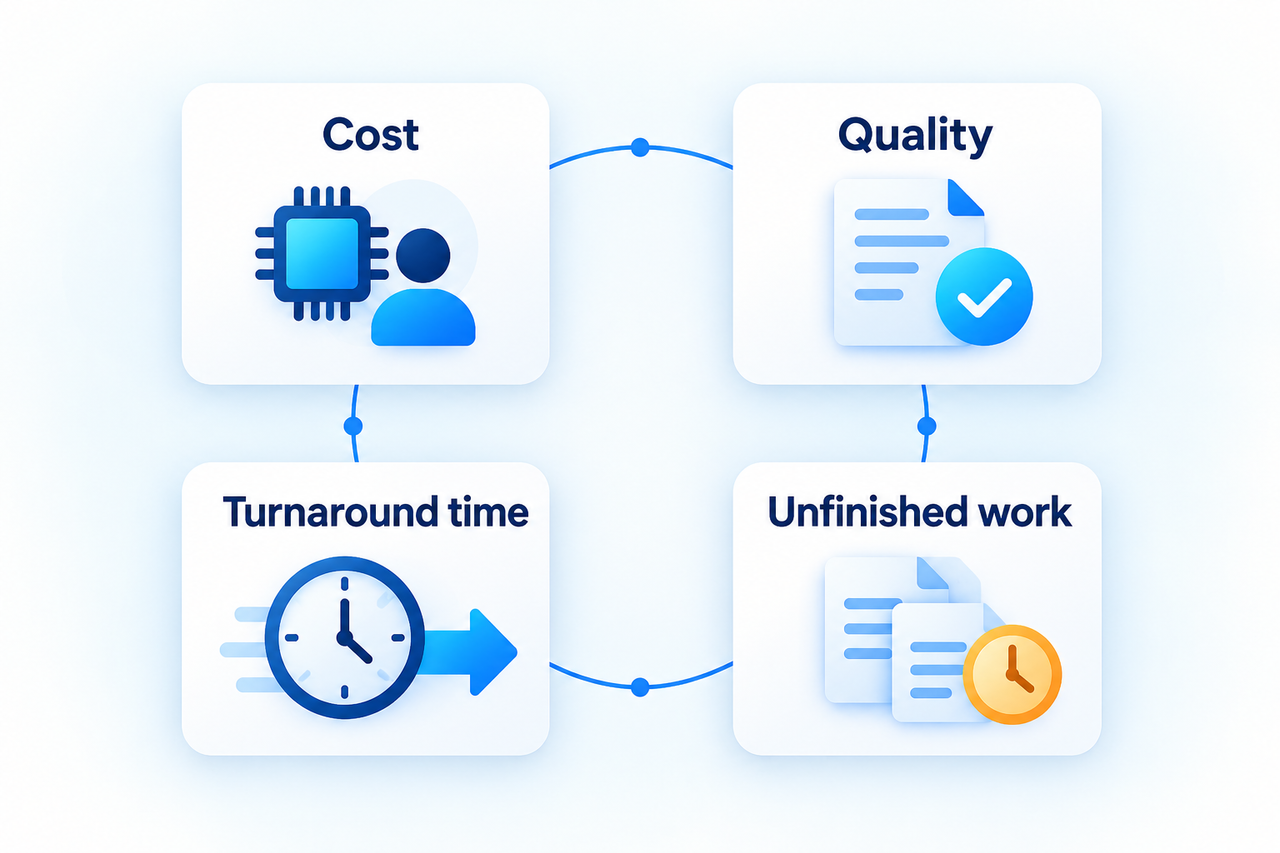
Cost belongs beside measures that describe how work gets done:
- Completion: accepted completions, unresolved requests and the age of open work.
- Human effort: review time, exception-handling time and the reasons for intervention.
- Quality: corrections, reopened cases and checks against the agreed acceptance criteria.
- Turnaround: elapsed time from receipt to the defined completion point.
Record what each measure means. “Reviewed” is not the same as “corrected.” A required approval is not automatically rework. Waiting for a supplier response is different from being blocked by an integration failure.
For turnaround time, show more than an average when possible. A median describes the typical completed request; a higher percentile, such as the 90th, helps reveal slower cases. Report open-request ages separately so that long-running unfinished work does not disappear from the view.
Compare similar work. Straightforward invoices should not be treated as equivalent to a batch with unfamiliar suppliers, missing references and complex disputes. Where useful, separate results by request type or complexity.
The purpose is to identify where effort, delay and risk remain, then decide what to improve.
Use the results to choose the next improvement
Suppose model charges are small but reviewers spend substantial time finding missing purchase-order references. Switching to a cheaper model may barely change the overall result. Improving the submission form or making the reference easier to retrieve could be more valuable.
If retries are common, investigate their cause. If most delays happen during approval, examine routing and ownership. If corrections concentrate in one document type, review that part of the process before expanding the pilot.
Avoid treating every human step as a failure. Some review is a deliberate control. The question is whether the workflow supports that review efficiently, with enough information for a reliable decision.
Compare against a credible baseline
A comparison needs the same completion definition, similar case complexity and consistent cost boundaries. Use a comparable observation window so one group does not have substantially more time to finish than the other.
Use observed effort where available. If the starting point relies on estimates, label them and improve them as evidence becomes available.
Also distinguish capacity released from cash saved. Reducing manual handling may give a team more time for other work without reducing payroll expenditure. That can still be valuable. Describe the benefit accurately rather than turning every minute saved into a financial saving.
Before claiming ROI, assess the wider costs and benefits, including setup, training, ongoing support and how released capacity is actually used.
Where Yeeflow fits
Yeeflow is an enterprise AI application and execution platform. Its forms, structured data lists and workflow resources provide a foundation for organizing requests and business records. Its workflow automation capabilities support approvals, routing and tasks.
For a measurement pilot, decide which operational fields to capture, then reconcile those records with provider charges and human-effort data. A practical starting record includes a request ID, received date, request type, current status, completion date, exception reason and review effort.
This is a measurement approach to configure and validate. It does not mean Yeeflow automatically provides complete cost-per-outcome metering or reconciles every provider charge.
Start with one process
Choose one clearly defined outcome and agree on five things before the pilot begins:
- The acceptance conditions and reopen rule.
- The request group and reporting cutoff.
- The included costs and shared-cost allocation.
- The quality, turnaround and unfinished-work measures.
- The baseline and who will review the findings.
Review the results together, then change one meaningful part of the process and measure again.
The goal is to understand whether the business is getting useful work completed more effectively, and where the next improvement will matter most.