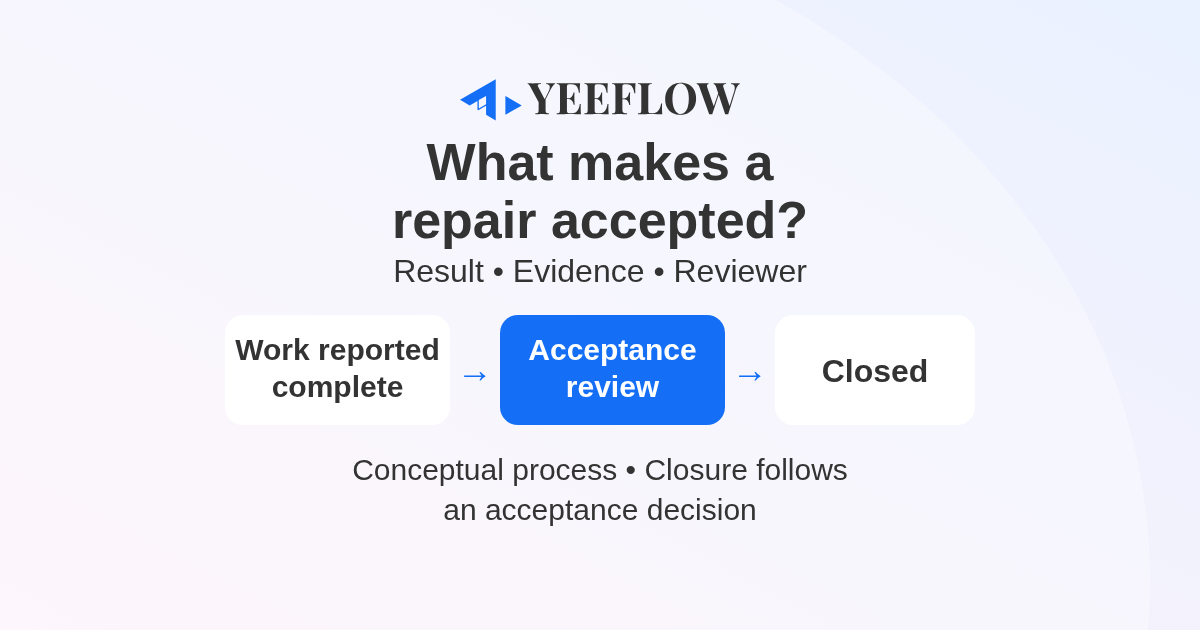
Closing a record should follow an evidenced acceptance decision.
The contractor has left. A completion photo is attached. The work order says “Done.” Then the occupant reports the same problem again, and the property team has to work out what was repaired, what was checked and who accepted the result.
A closure standard gives the team a shared answer before that disagreement happens. It defines the result required, the evidence that supports it and the person responsible for accepting it. That makes “closed” a decision somebody can explain, rather than the last status available in a form.
Start with one recurring, routine maintenance category. Agree what acceptance means for that category before designing its form or workflow.
Separate work completed from work accepted
A contractor's completion report answers one question: what work does the contractor say was carried out? Acceptance answers another: does the available evidence meet the agreed requirement?
Both belong in the record. Combining them into a single checkbox makes it difficult to see whether the work is waiting for inspection, waiting for missing information or actually accepted.
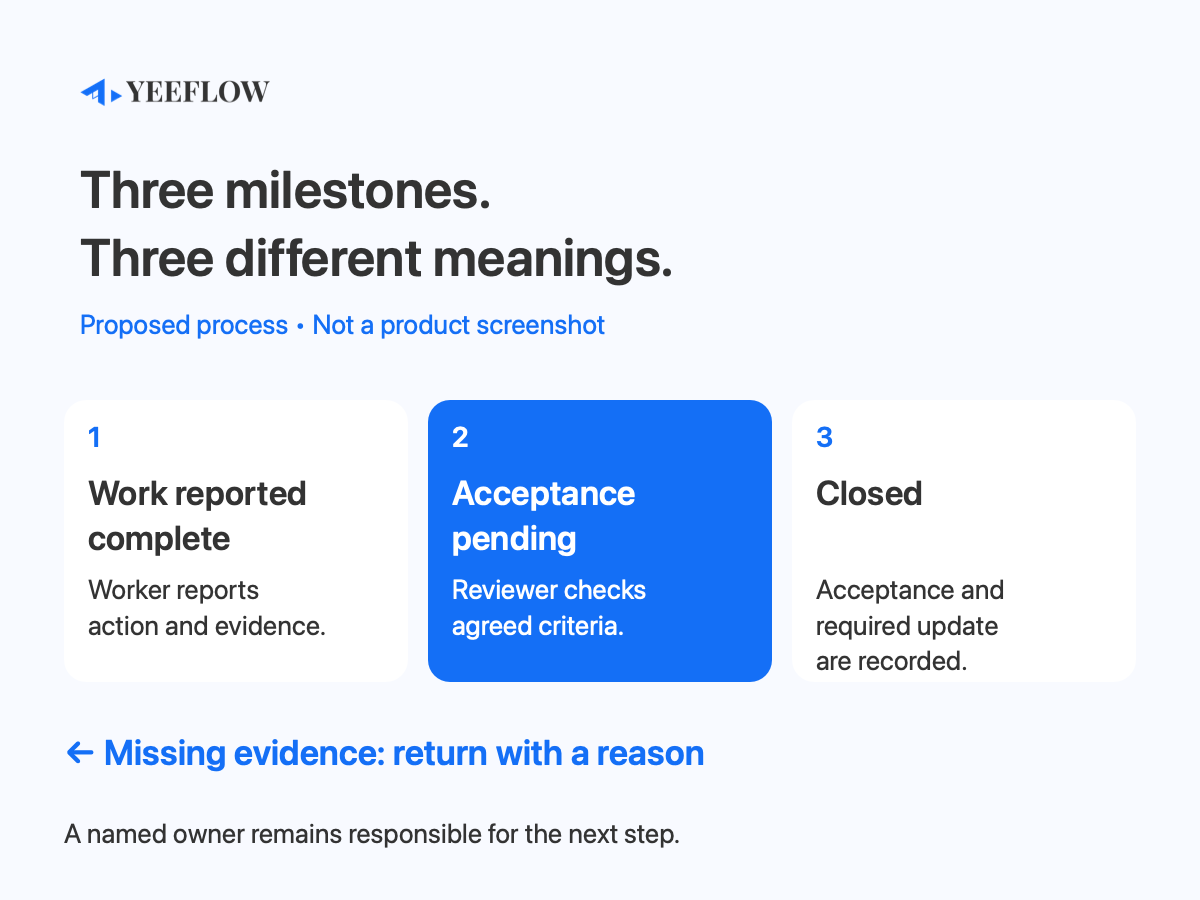
For a routine maintenance process, consider three distinct milestones:
- • Work reported complete: the assigned worker has described the action and submitted the required evidence.
- • Acceptance pending: the designated reviewer is checking that evidence against the agreed criteria.
- • Closed: the reviewer has recorded the acceptance decision and any required follow-up communication is complete.
These are proposed process labels, not mandatory terminology. Keep your existing system's names where they work, but make the meaning and responsibility behind each status explicit. A declined acceptance should return the case to a named owner with a reason, not leave it indefinitely in a generic “In progress” state.
Define the result before requesting evidence
“Attach a photo” is a collection requirement. It does not explain what the photo must demonstrate. Before choosing attachments or mandatory fields, write a short acceptance statement for the type of work.
For example, a routine cabinet-door repair might need the correct door to open and close as intended, the reported alignment problem to be resolved and the surrounding area to be left in the agreed condition. The competent reviewer determines the appropriate checks; a photograph alone may not demonstrate movement or fit.
Use the relevant site procedures and qualified personnel for technical checks. This article describes record and decision design, not maintenance instructions or a substitute for required inspections. High-risk or regulated work needs its own applicable controls.
A practical closure record can connect five questions:
Closure question / What to record
What result was agreed?
The defect, precise location or asset reference, work scope and acceptance criteria
What work was reported?
The action taken, person or contractor, completion time and any unresolved item
What supports acceptance?
Evidence tied to the correct job, with its source, date and relevant check result
Who accepted or declined it?
The authorised reviewer, decision, time and reason
What happens next?
Required communication, open follow-up work and the route for reporting a recurrence
Keep attachments relevant and access-controlled. Avoid collecting occupant details or unrelated interiors merely to make the record look complete. Where evidence cannot be obtained, record the gap and the responsible next step rather than entering a reassuring value without support.
Follow one fictional case through acceptance
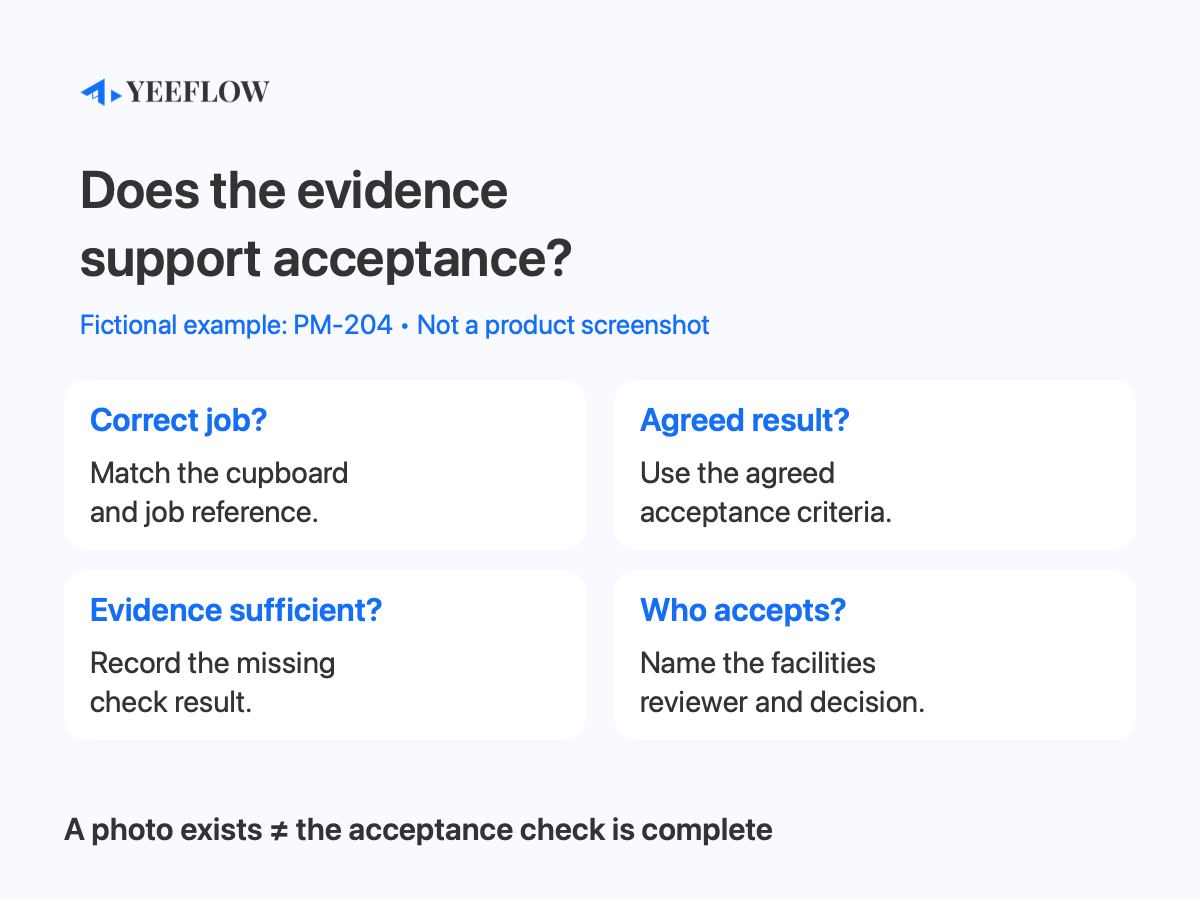
Consider PM-204, a fictional request for a misaligned cupboard door in a shared meeting-room kitchenette. The request identifies the cupboard and includes a description of the issue. The property coordinator agrees the work scope and the appropriate acceptance checks with the maintenance team.
After the repair, the technician submits a completion note and a photograph. The note identifies the action taken and reports that the door was checked. The case moves to Acceptance pending, with the facilities reviewer responsible for the decision.
The reviewer finds that the photograph shows the correct cupboard, but the completion note does not establish that the agreed opening-and-closing check was completed. The reviewer requests that missing result and records why acceptance is pending. The team does not close the case merely because an attachment exists.
Once the required evidence is available, the reviewer records an acceptance decision against the agreed criteria. The property coordinator completes the required update to the requester. The record can now show who accepted the work, on what basis and when the requester was informed.
The people, identifier and sequence here are illustrative. They do not describe a Yeeflow customer implementation, a product demonstration or a guaranteed technical outcome.
Keep a clear path for recurrence
A closed case should still be understandable if the issue returns. Agree how the team distinguishes an unresolved original defect from a new issue at the same location. The responsible reviewer may need to make that judgment; a matching address alone is insufficient.
If the original case is reopened, retain its earlier completion report, acceptance decision and timestamps. Add the new report, reason for reopening, current owner and next checkpoint. If your process creates a new case instead, link it to the previous record and explain the relationship. Do not erase the history to make the latest status look simpler.
Also distinguish a remaining action from a completed repair. If the original scope has only been partly met, the record should not imply full acceptance. Where a separately accepted item generates additional work, show that work's owner and reference clearly. Closing one record must not make an outstanding obligation disappear.
Turn the standard into a bounded building brief
The agreed closure criteria can become a concrete brief for a form and workflow. Specify the information to collect, who may report completion, who may accept it, how missing evidence is returned and what happens when a case reopens.
For an application administrator using Yeeflow, the AI approval-form guide describes starting in Add resource → New application resource, selecting Approval form in Create with AI, and describing the requirements. Review the Implementation Plan, clarify changes and confirm it before creation proceeds. Then inspect and test the resulting form and workflow before making them available to users.
A proposed prototype brief could say:
Create a maintenance completion-review form. Collect the job reference, reported work, relevant evidence and unresolved items. Separate contractor completion from facilities acceptance. Let the reviewer request missing evidence with a reason. Preserve the acceptance history when a recurrence is reviewed.
This is a design request to evaluate, not a claim that every requested rule will be generated correctly. Check the actual fields, permissions and routing. The guide also explains how to return to the saved conversation under Ask AI → Build with AI after closing the creation dialog. Review and test refinements deliberately: draft changes do not automatically publish the approval form.
Test the cases that could produce a misleading closure
Before a pilot, walk through representative fictional records with the people who will use the process:
- 1. A completion report is submitted without the agreed evidence.
- 2. An attachment belongs to another location or job.
- 3. A reviewer declines acceptance and explains what is missing.
- 4. The assigned reviewer is unavailable and the agreed backup must act.
- 5. Work is only partially complete, with an unresolved item.
- 6. The same issue is reported after closure and must be linked or reopened.
For each case, check the visible status, responsible owner, permitted actions and preserved history. Test notifications and any connected systems only within the approved environment and scope. A working happy-path form does not prove these exception paths are correct.
For an initial review, count acceptance decisions separately from contractor completion reports. Examine missing-evidence returns, time awaiting acceptance and reopened cases by maintenance category. Define the observation window and eligible cases before interpreting a rate. A lower backlog is not, by itself, proof of better repairs.
Bring one recent routine work order to your next process review and ask: Could another authorised colleague explain why this was accepted without calling the original reviewer? If not, start by improving the closure standard. For the broader creation and refinement approach, read Yeeflow's Build with AI release overview.