A delivery update arrives near the end of a shift: “The vehicle is delayed. Please follow up.” The next team can see that something has changed, but the message leaves several questions open. Which commitment is at risk? What is confirmed? Who can approve a different plan? When does somebody need to decide?
Forwarding the update gives another person the same unanswered questions. A useful logistics exception handoff should give that person enough context to take responsibility for a specific next step.
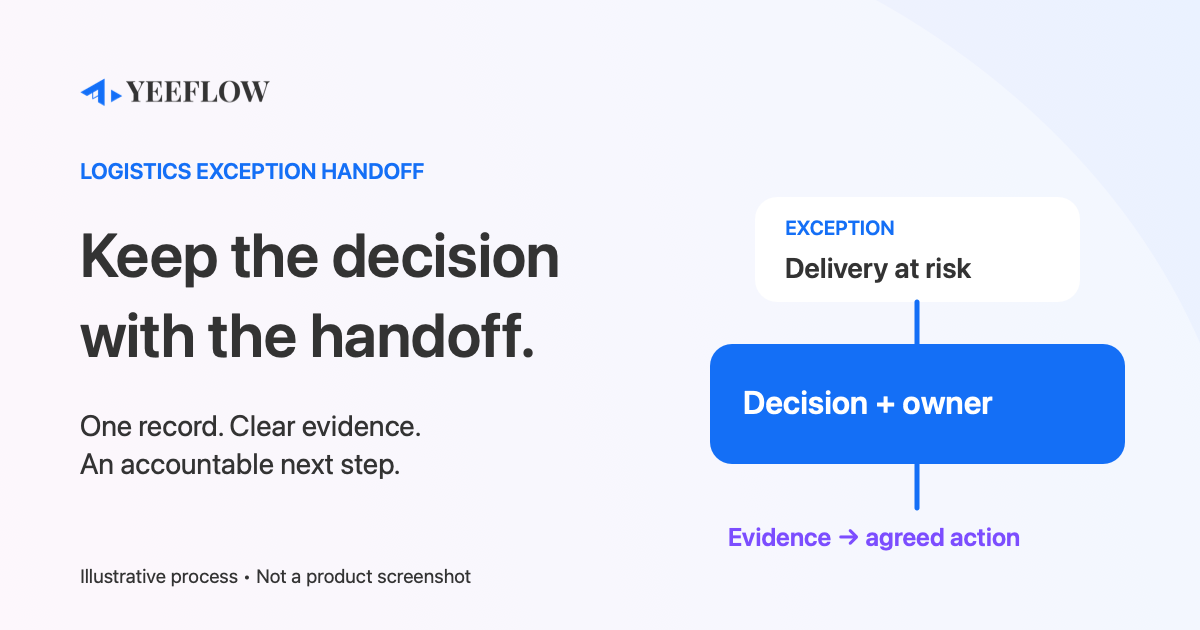
Start with one sentence: “We need this owner to make this decision by this time, using this evidence.” Then build the record, status and review around it.
Separate the disruption from the decision
“Delayed shipment” describes a condition. It does not describe the action required. The decision might be whether to change the receiving appointment, investigate a missing document, offer a partial delivery or keep the original plan while obtaining better information.
Each choice has different evidence and authority requirements. A coordinator may be able to request an updated arrival estimate but not approve extra transport costs. A customer-service colleague may communicate an agreed plan but not commit a receiving site to a new slot.
Choose one recurring exception for your first improvement. Ask the people handling it what decisions they actually make, what information they need and which commitments they cannot make themselves. Keep those boundaries visible in the handoff.
Give the next owner a compact decision record
The record should answer the next person's immediate questions without requiring them to reconstruct an entire email chain. A practical starting structure is:
- Shipment or job reference: The identifier used in the relevant operational system, with a link where access permits
- Exception and impact: What changed and which delivery, receiving or customer commitment might be affected
- Confirmed evidence: The source, observation time and relevant document or message
- Unknowns: Information still needed, who is obtaining it and when it will be checked
- Decision required: A specific question with realistic options
- Accountable owner: The person or role responsible for the next decision, plus an agreed backup
- Decision deadline: The time and timezone, tied to a real operational constraint
- Next update: Who will communicate the decision, to whom and through which existing channel
- Closure evidence: What will demonstrate that the agreed action happened
Keep the record proportionate. A useful form is not the longest possible form. Make essential fields clear, allow an explicit “not yet known,” and separate reported information from verified facts. An estimated arrival is still an estimate, even when it appears in a structured field.
Work through one fictional handoff
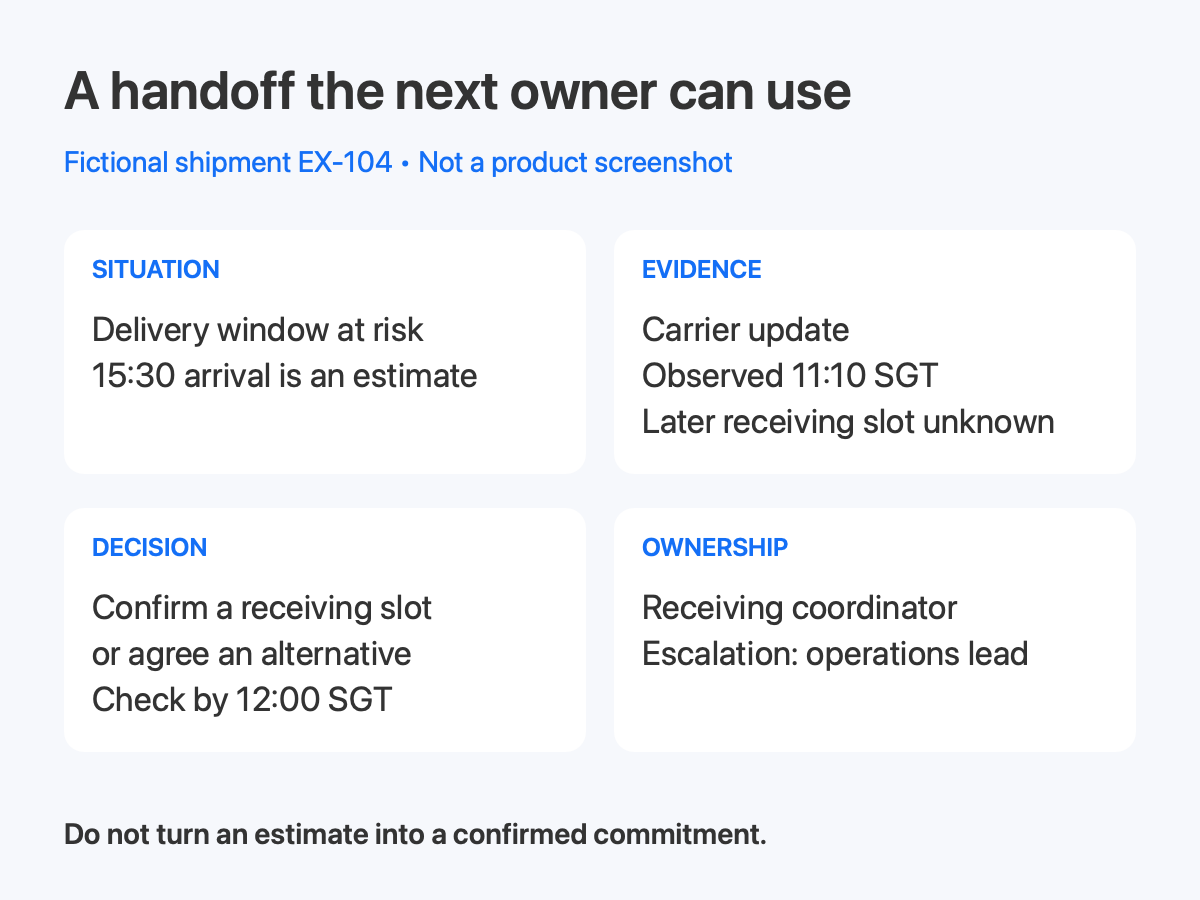
Consider a fictional shipment, EX-104, due at a receiving site at 14:00. At 11:10 Singapore time, the transport coordinator records a carrier update estimating arrival at 15:30. The receiving site's ability to accept a later arrival is unknown.
The handoff should not quietly turn that estimate into a confirmed appointment. A useful decision request would be:
Can the receiving coordinator confirm a revised slot today, or should the operations lead agree an alternative plan? Check by 12:00 SGT, before the team communicates a revised commitment.
The carrier message is linked as evidence with its timestamp. The receiving coordinator owns the slot check. The operations lead is the agreed escalation owner if the receiving constraint cannot be resolved. Customer service waits for the agreed decision before communicating a new commitment.
Suppose the receiving coordinator confirms a 16:00 slot at 11:45. Record the source of that confirmation and the person who made it. Then assign the next action: confirm the revised plan with the carrier and communicate it to the relevant customer contact. The case stays open until those actions and the agreed closure evidence are recorded.
These are illustrative roles, times and steps, not a customer result or a prescribed logistics policy. Adapt them to your team's actual responsibilities and operating constraints.
Make status describe the next action
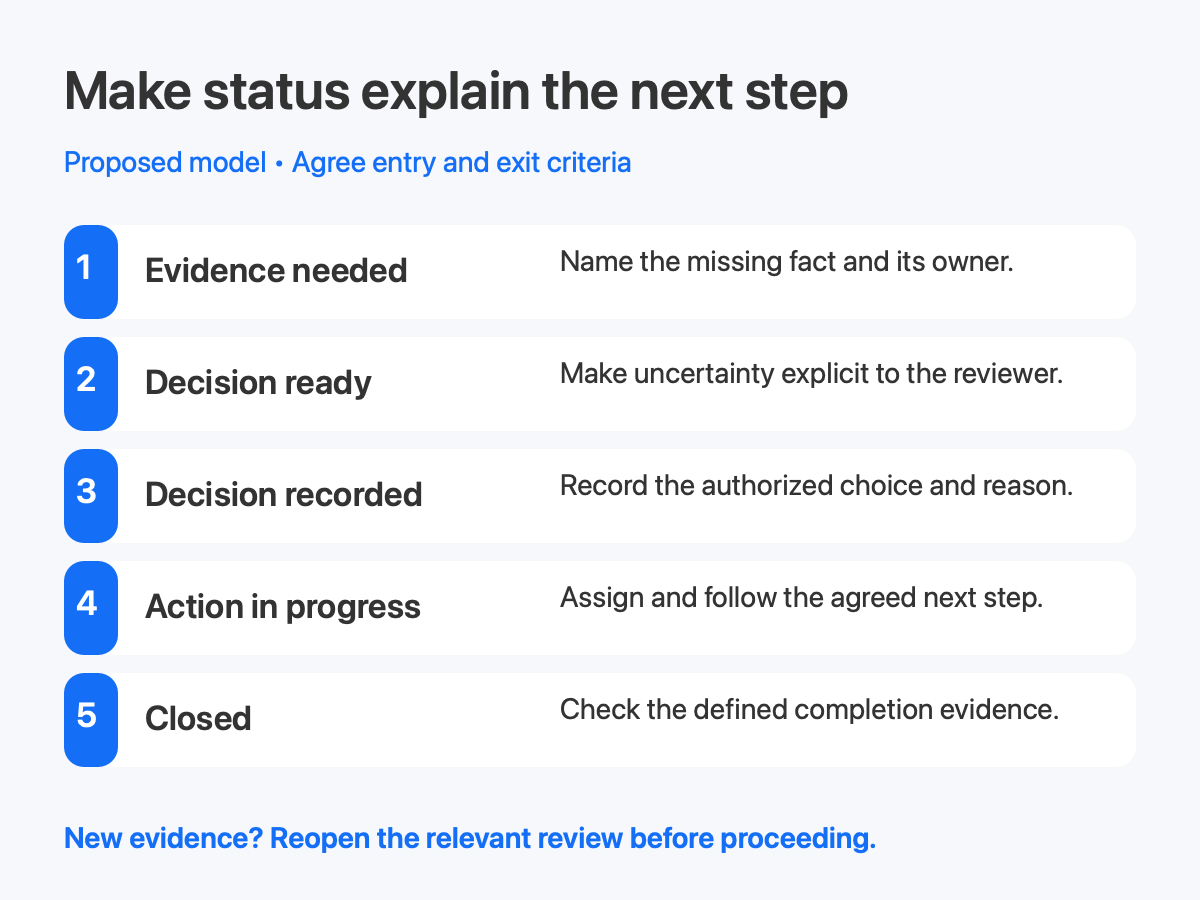
A status such as “In progress” may cover several very different situations. For the selected exception, consider statuses that help the next owner understand what remains:
- Evidence needed: a named person is obtaining a specific missing fact.
- Decision ready: the information required for the agreed decision is available.
- Decision recorded: an authorized owner has selected the next step and recorded the reason.
- Action in progress: a named person is carrying out that step.
- Closed: the defined completion evidence has been checked.
Agree entry and exit criteria with the people who will use these labels. “Decision ready” must not mean that every uncertainty has disappeared; it means the remaining uncertainty is explicit and acceptable to the decision owner.
A missed deadline needs a defined response too. Decide who checks it, who takes over if the owner is unavailable and how to avoid sending conflicting instructions. An escalation should preserve the evidence and decision history, rather than create another disconnected version of the case.
Use AI-assisted building after defining the handoff
Once the team agrees the record and decision boundaries, it has a clearer brief for an application builder. Yeeflow's Help Center describes application resources including structured data lists and forms with workflows, alongside AI-assisted creation and continued refinement through saved conversations.
For this scenario, a builder could use the agreed handoff structure as the starting requirement for a bounded prototype. The design request should distinguish the information to collect, the people allowed to decide, the actions requiring confirmation and the evidence needed to close the case.
Review the proposed structure and test the configured behavior before using it for live shipments. A generated starting point does not establish that permissions, routing, integrations or notifications match your operation. This article does not demonstrate an installed logistics solution or a tested connection to a carrier or transport-management system.
Test the awkward cases before expanding
Use fictional records to test more than the straightforward path. What happens when the carrier revises its estimate? Can a second shift see the reason for the decision? What if the owner is absent, the receiving site declines the proposed slot or a case is closed before the customer update is confirmed?
Ask a colleague who did not design the process to review a sample handoff. Can they identify the current owner, the decision required, the strongest available evidence and the next checkpoint? If they must ask the original sender to explain every field, improve the record before adding more automation.
For a small pilot, choose measures your existing records can support: time from reporting to owner acknowledgement, time from sufficient evidence to a recorded decision, missing-information returns and cases reopened after closure. Define the start and end events, timezone and eligible cases. Keep observations separate from assumptions; a shorter response time alone does not prove a better operational outcome.
A handoff readiness check
Before moving the next exception to another team, confirm:
- The affected commitment and decision are explicit.
- Evidence has a source and observation time; estimates and unknowns are labelled.
- One accountable decision owner and an agreed backup are identified.
- The deadline has a timezone and a reason.
- Communication responsibility and closure evidence are clear.
Bring one recurring exception to your next process review and complete that sentence together: who needs to decide what, by when, using which evidence?
To explore how that agreed process can inform an application-building brief, read Yeeflow's Build with AI release overview. Start with a bounded prototype and review its behavior before introducing it into live operations.