Why Every Organization Needs a Modern Service Portal
Digital transformation is no longer limited to employees inside the organization.
Today, businesses interact with customers, partners, suppliers, distributors, contractors, and members through an increasing number of digital touchpoints. Customers expect to submit service requests online, partners need to collaborate on shared projects, suppliers want visibility into procurement processes, and members expect personalized digital services—all without relying on emails, phone calls, or disconnected systems.
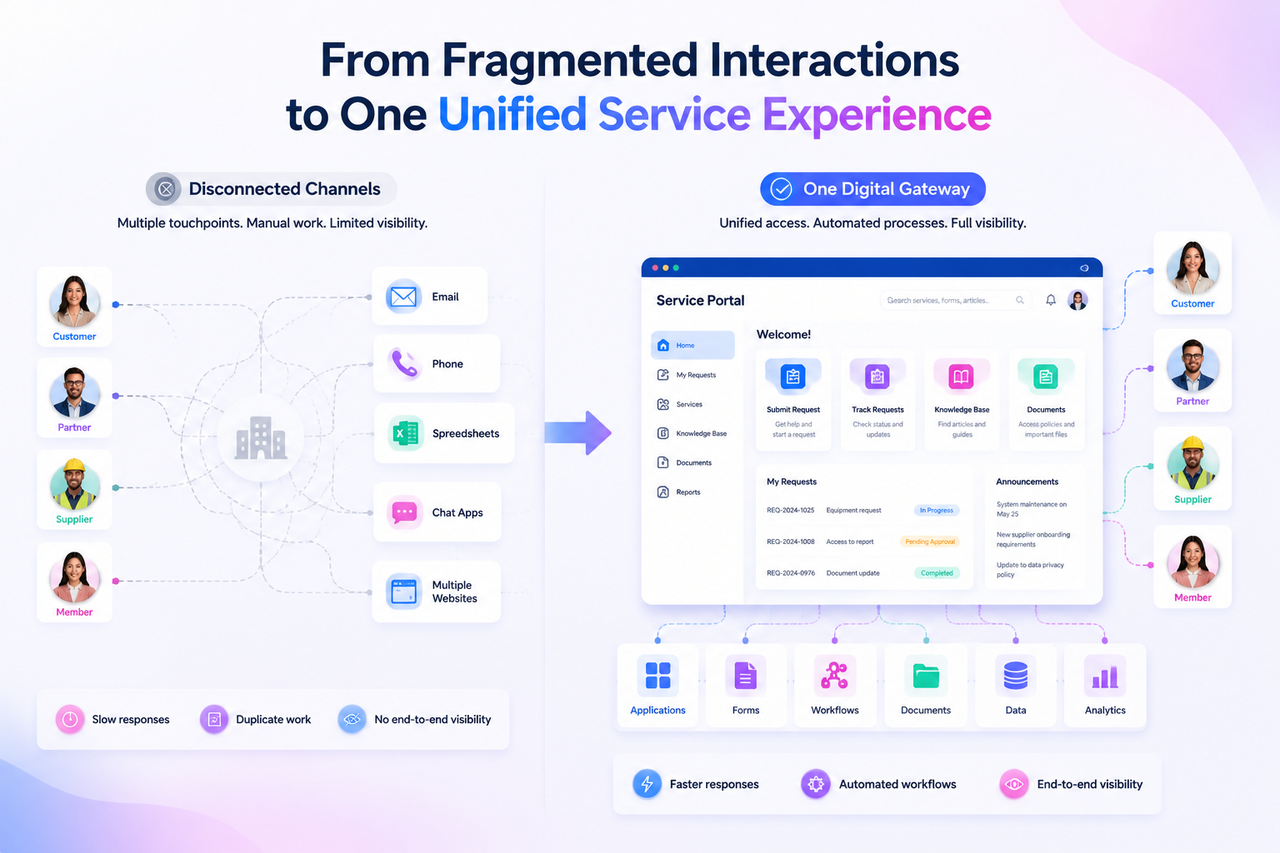
Yet many organizations still struggle with fragmented external experiences.
Customers are asked to email support teams instead of submitting requests online. Partners need to log into multiple systems to access documents or complete business tasks. Suppliers communicate through spreadsheets and messaging applications. Different departments create separate websites, each maintaining its own user accounts and authentication methods.
The result is an inconsistent experience for external users and growing operational complexity for the organization.
Multiple entry points make services difficult to find. Duplicate account management increases administrative overhead. Disconnected systems reduce visibility into business processes. Most importantly, users become frustrated before meaningful collaboration even begins.
This is why Service Portals have become an essential part of modern digital business.
A Service Portal provides a single digital destination where external users can securely access applications, submit requests, participate in workflows, retrieve information, and collaborate with your organization. Rather than forcing users to navigate multiple systems, it creates one consistent experience that brings together business services, applications, and processes in one place.
However, simply publishing a portal is no longer enough.
To encourage adoption, a modern Service Portal must deliver an experience that is intuitive, secure, and designed around the people who use it.
A Great Service Portal Is More Than Just a Website
Many organizations begin building a Service Portal by focusing on the homepage or login screen. While those elements are important, they represent only a small part of the overall experience.
A successful Service Portal should feel like a natural extension of the organization's brand. From logos and color schemes to page layouts and customized styling, every interaction should reinforce a professional and consistent identity. External users should immediately recognize that they are engaging directly with your organization—not simply accessing another business application.
Beyond appearance, navigation plays an equally important role.
As organizations expand their digital services, users need an easy way to discover applications, forms, knowledge articles, reports, and business services without switching between multiple platforms. Clear navigation helps users find what they need quickly, reducing confusion and improving overall satisfaction.
Access management is another critical component.
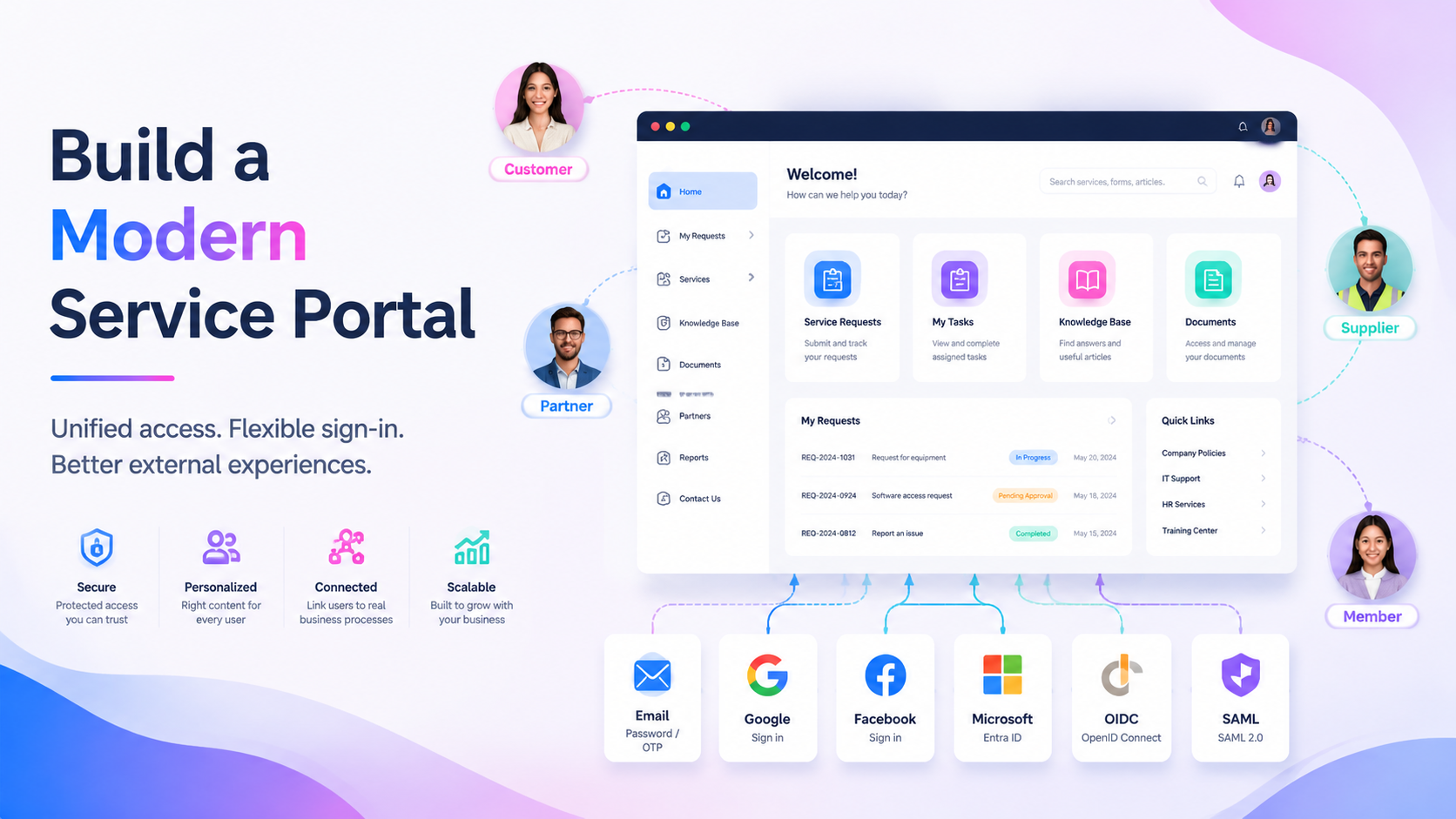
Customers, partners, suppliers, and contractors rarely require the same information or permissions. Each audience should see only the services, applications, and data that are relevant to them. Effective user management, user groups, and permission controls ensure that every user receives a personalized experience while maintaining enterprise security and governance.
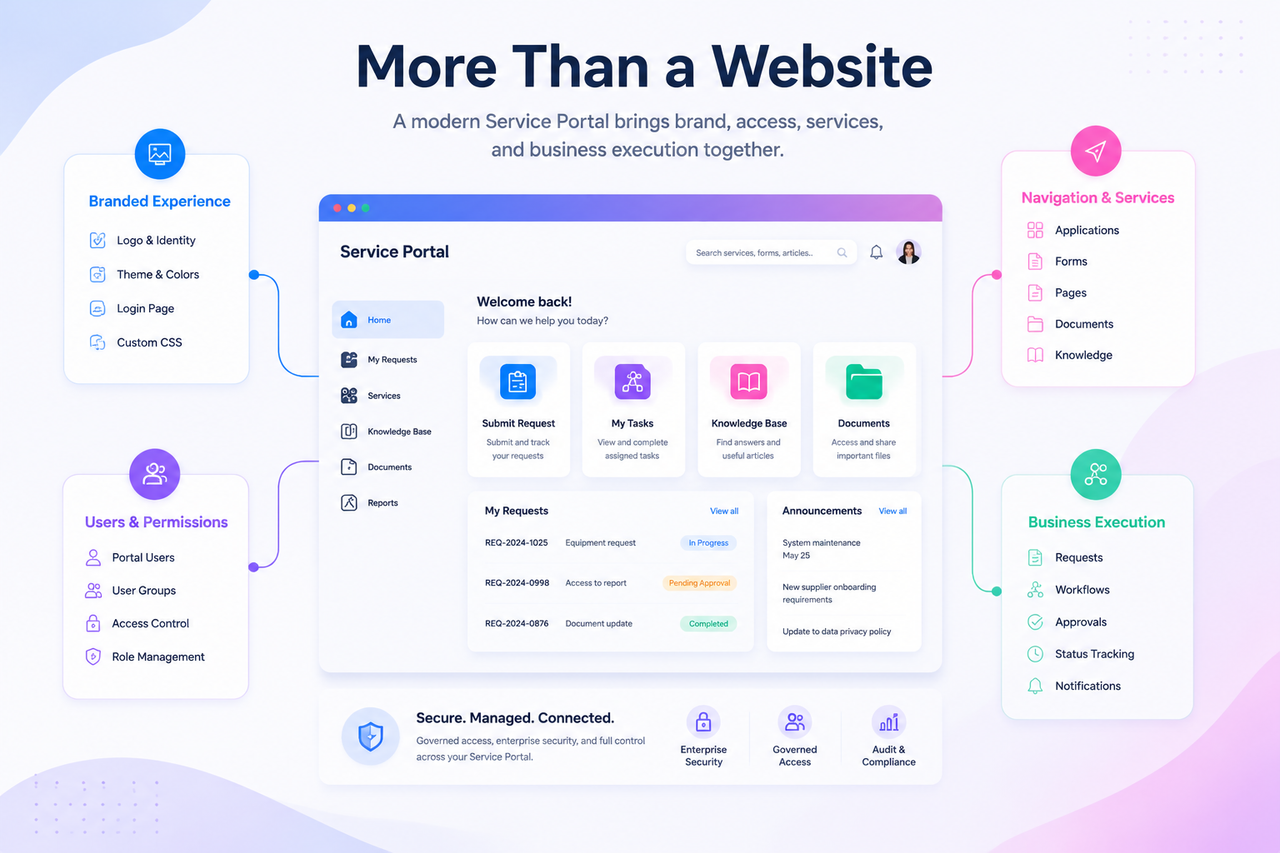
Most importantly, a Service Portal should connect users directly to real business processes.
Submitting a request should automatically trigger workflows. Uploaded documents should enter approval processes. Users should be able to track request status, receive notifications, and collaborate with internal teams throughout the entire business process.
In other words, a modern Service Portal is not simply a website—it is a digital business platform that connects external users to the organization's operational processes.
Every Great Portal Experience Begins with Sign-In
Even the most sophisticated Service Portal cannot deliver value if users struggle to access it.
The first interaction users have with any portal is signing in. If that experience feels complicated, confusing, or unnecessary, many users will simply abandon the process before engaging with any business service.
This challenge is more common than many organizations realize.
Consumers often do not want to create yet another username and password just to submit a support request or download documentation. Business partners prefer using their existing corporate identity rather than maintaining separate credentials. Occasional visitors frequently forget passwords, while long-term users expect stronger security and account management.
These different expectations mean that a single authentication method rarely satisfies every audience.
Instead, organizations should design their authentication strategy around the people using the portal.
For B2C Portals: Prioritize Convenience and Accessibility
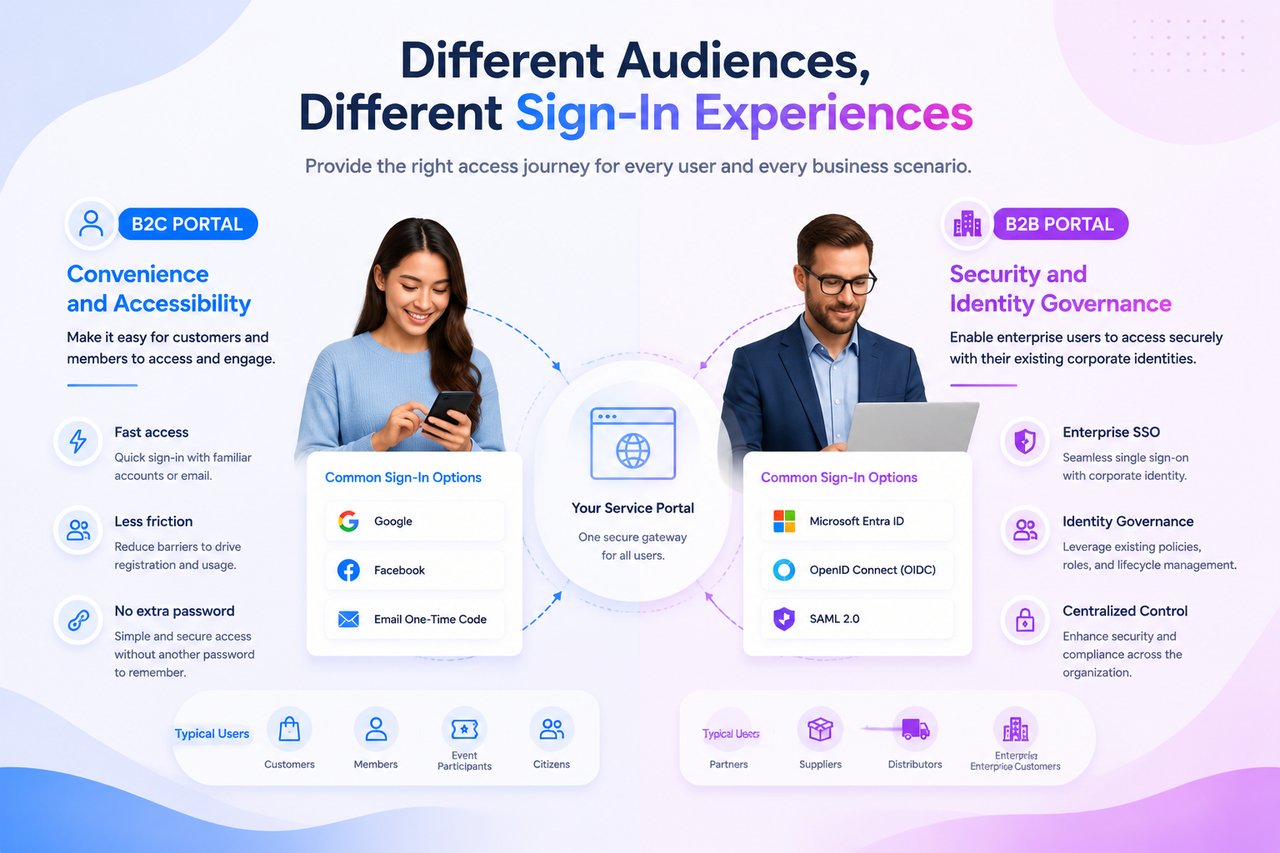
Customer service portals, membership portals, public services, and event registration platforms typically serve users who value speed and simplicity above all else.
Requiring new account registration for every interaction introduces unnecessary friction. Many users already trust and regularly use services such as Google or Facebook for authentication. Others simply want to verify their email address and continue without remembering another password.
Providing familiar sign-in options significantly reduces barriers to entry, encourages first-time adoption, and increases the likelihood that users will continue using the portal in the future.
For consumer-facing experiences, convenience often drives engagement.
For B2B Portals: Balance User Experience with Enterprise Security
Business collaboration presents different requirements.
Partners, suppliers, distributors, and enterprise customers usually operate within established corporate identity systems. They expect to authenticate using their existing organizational accounts while maintaining enterprise security standards.
Supporting Microsoft Entra ID, OpenID Connect (OIDC), or SAML enables organizations to integrate their Service Portal with existing identity providers, allowing users to enjoy a seamless single sign-on (SSO) experience without managing additional credentials.
For IT teams, this approach also simplifies identity governance by continuing to leverage existing authentication policies, security controls, and user lifecycle management.
Rather than creating another identity system, organizations extend the one they already trust.
Different Users Deserve Different Authentication Experiences
Not every user fits neatly into either B2B or B2C scenarios.
Long-term portal users may still prefer traditional email and password authentication supported by password policies, reset capabilities, and stronger account security.
Occasional users, temporary contractors, or first-time visitors may benefit from one-time email verification codes that eliminate password management entirely.
The goal is not to choose a single authentication method.
The goal is to provide the right authentication experience for each type of user.
A modern Service Portal should adapt to different business scenarios instead of expecting every user to adapt to the portal.
Building Modern Service Portals with Yeeflow
Yeeflow Service Portal is designed to help organizations create branded, secure, and highly configurable digital experiences for external users.
Organizations can customize portal appearance, navigation menus, login pages, branding, custom CSS, portal users, user groups, and permission settings to create portals that reflect both their business requirements and corporate identity.
Authentication is an important part of that experience—but it is only one part.
Yeeflow supports multiple authentication options that allow organizations to select the most appropriate sign-in experience for each portal, including:
- Email and Password
- Email One-Time Code
- Google Login
- Facebook Login
- Microsoft Entra ID
- OpenID Connect (OIDC)
- SAML 2.0
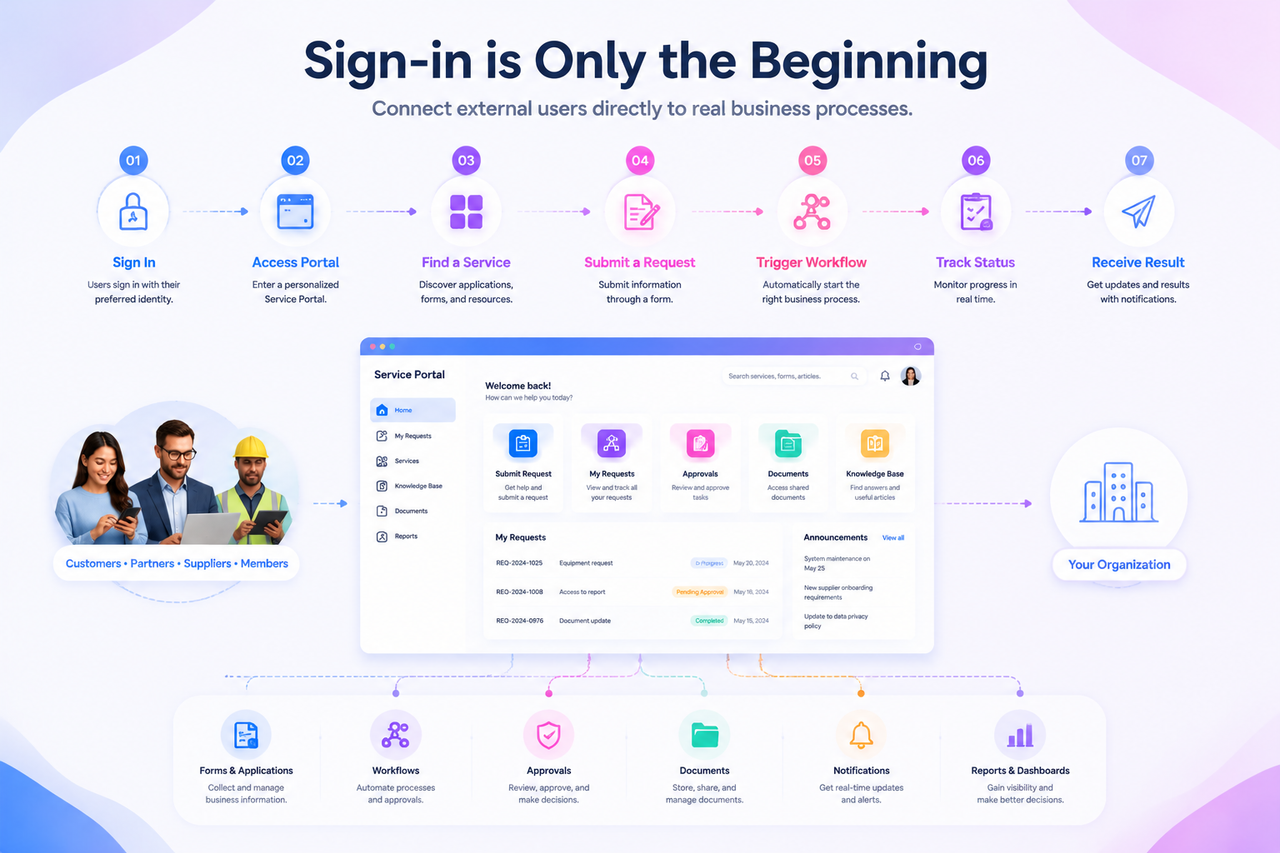
This flexibility enables organizations to support a wide variety of business scenarios.
A customer support portal can offer Google sign-in or email verification for quick access. A partner portal can integrate with Microsoft Entra ID to provide enterprise single sign-on. Supplier portals can authenticate through SAML, while membership portals can continue using traditional email and password authentication with enterprise security policies.
Because these capabilities are part of the same platform, organizations can create multiple Service Portals for different audiences without maintaining separate identity systems or rebuilding authentication for every application.
The result is a consistent, secure, and scalable experience across every external-facing business service.
Every Login Is the Beginning of a Better Service Experience
A successful Service Portal is not defined by how users log in.
It is defined by what users are able to accomplish after they arrive.
When external users can quickly access the right services, collaborate securely, and complete business processes without unnecessary barriers, organizations create stronger relationships with customers, improve partner collaboration, streamline supplier engagement, and deliver better digital experiences overall.
Authentication is not simply a security feature—it is the first step in that journey.
By combining branded portal experiences, centralized business services, flexible identity management, and enterprise-grade governance, organizations can build Service Portals that people genuinely want to use.
With Yeeflow Service Portal, businesses can deliver exactly that: a unified, secure, and flexible digital gateway where every customer, partner, supplier, and external user enjoys an access experience that matches their needs—making every sign-in the beginning of meaningful business collaboration.