AI is becoming more powerful across business software.
But in most products, that power still stops too early.
It can answer questions.
It can summarize information.
It can generate content.
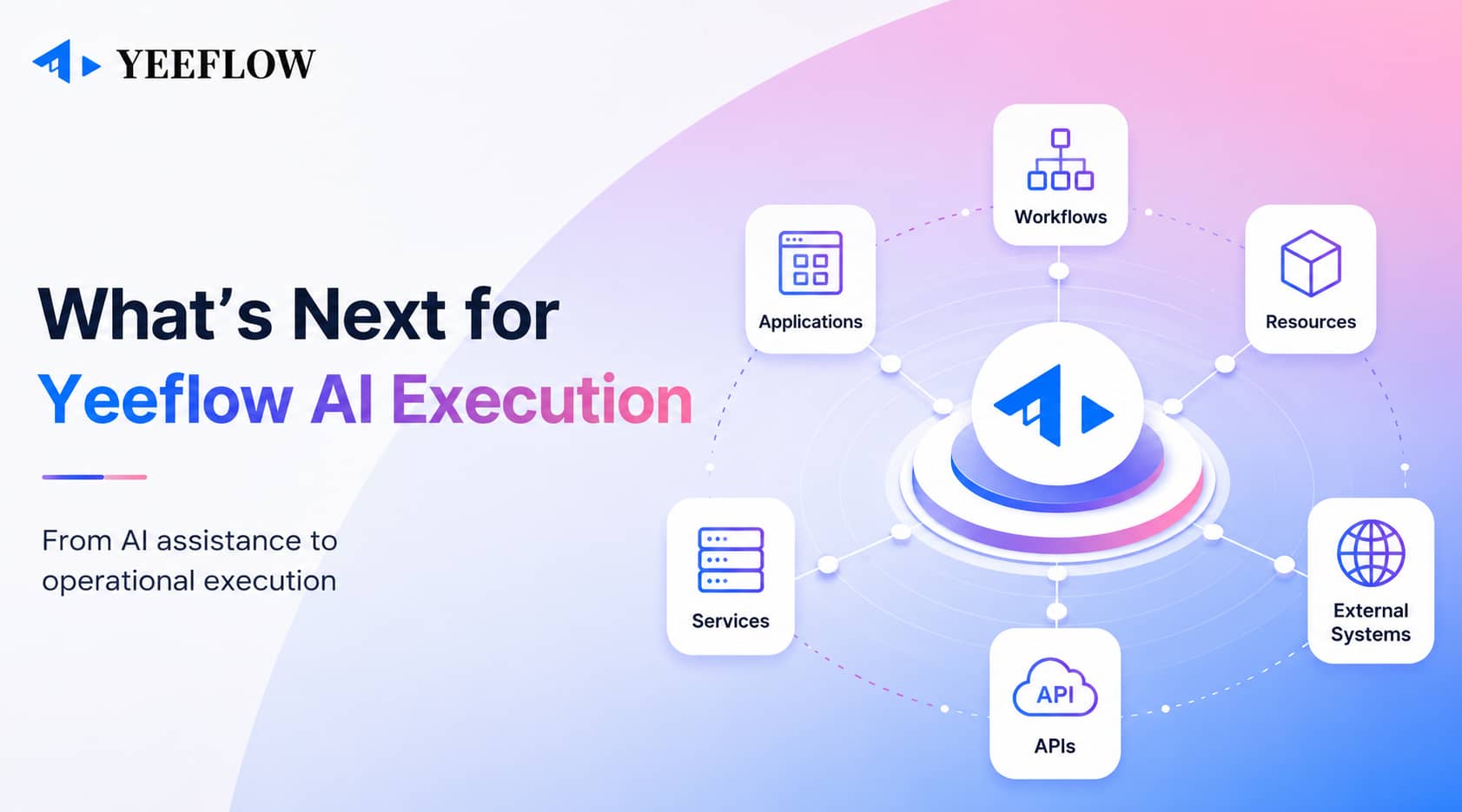
What it often cannot do well is participate in real business execution — across workflows, resources, services, and external systems.
That is the direction Yeeflow is building toward in 2026.
Yeeflow’s strategy is not to treat AI as a disconnected feature layered on top of a no-code platform. It is to evolve into an enterprise AI application and execution platform — where organizations can build faster with AI, use AI inside real business applications, and let AI participate in governed operational work.
And now, the next step in that journey is coming into focus.
From AI assistance to AI execution
So far in 2026, Yeeflow has already made meaningful progress across AI-powered application creation, platform flexibility, integrations, and extensibility.
The January release expanded AI Builder into more practical creation scenarios, including approval forms, data lists, and field generation. The February release improved core builder usability and AI usage visibility. The April release then pushed further into model flexibility, custom AI connections, API interaction, portability, and AI-assisted coding. Together, these releases show a clear direction: Yeeflow is moving beyond AI-enabled features and toward a more complete AI-powered business application and execution platform.
That foundation matters because AI execution does not start with one single feature.
It requires multiple layers to come together:
- application context
- structured business data
- workflow logic
- resource access
- external integrations
- reusable platform capabilities
- safe operational boundaries
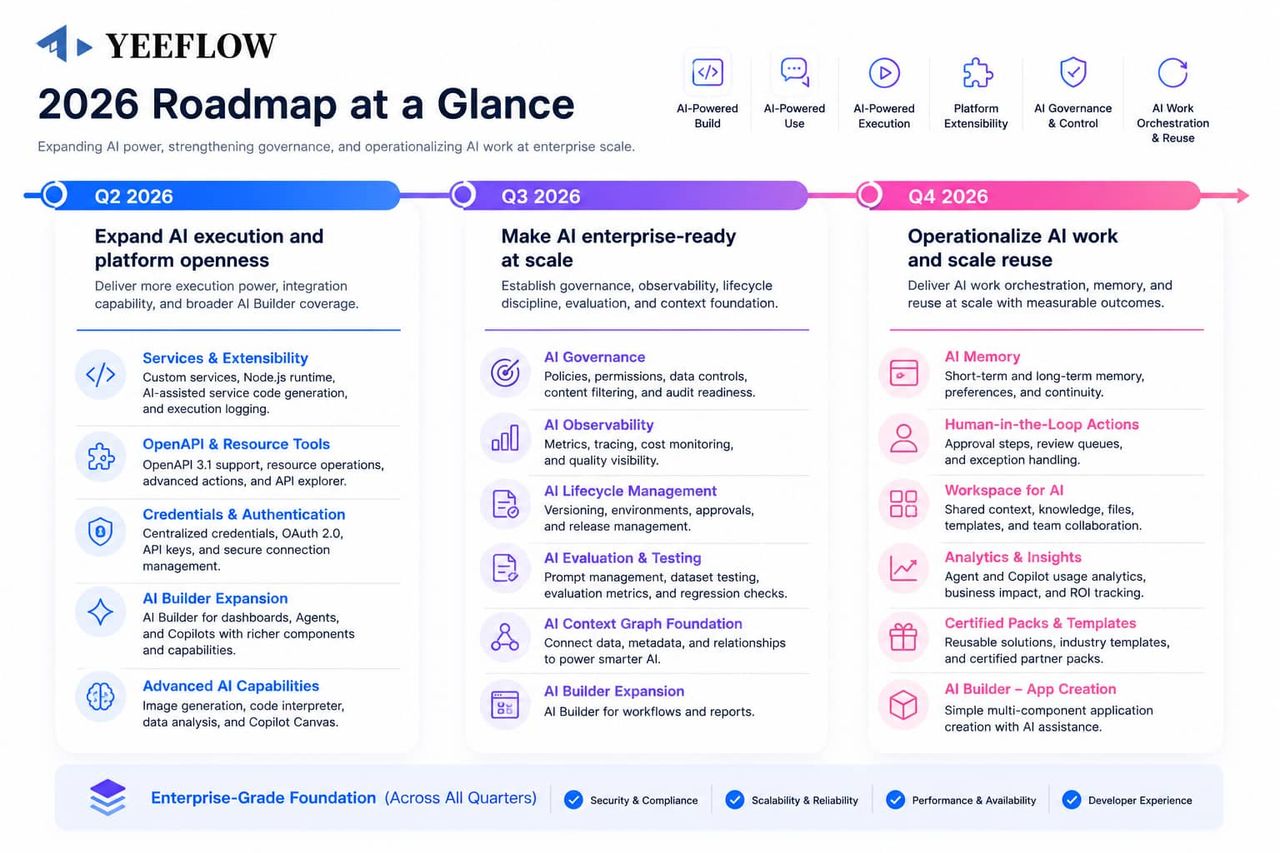
This is why Yeeflow’s 2026 roadmap is sequenced the way it is. H1 is focused on expanding AI capability and platform openness first, before deeper governance and operational control arrive later in the year.
Why Yeeflow AI execution matters
The long-term value of enterprise AI is not just better answers.
It is better execution.
That means AI should be able to do more than respond to a prompt. It should be able to:
- work inside business applications
- understand the operational context
- interact with structured resources
- connect to services and APIs
- generate richer outputs
- support real business actions
This is already reflected in Yeeflow’s 2026 strategy, where AI-powered execution is one of the core platform dimensions. In that model, AI Agents and Copilots are meant to act across workflows, application resources, services, and external systems — not remain limited to conversational assistance alone.
That is also why the roadmap makes Q2 about expanding AI execution and platform openness. The goal is to make Yeeflow visibly stronger in real business execution scenarios by allowing AI to do more work, use more tools, and generate more useful outputs.
What’s coming next
The next phase of Yeeflow AI execution is about making the platform more capable, more connected, and more operational.
Based on the current Q2 direction, that means expanding Yeeflow in several important ways.
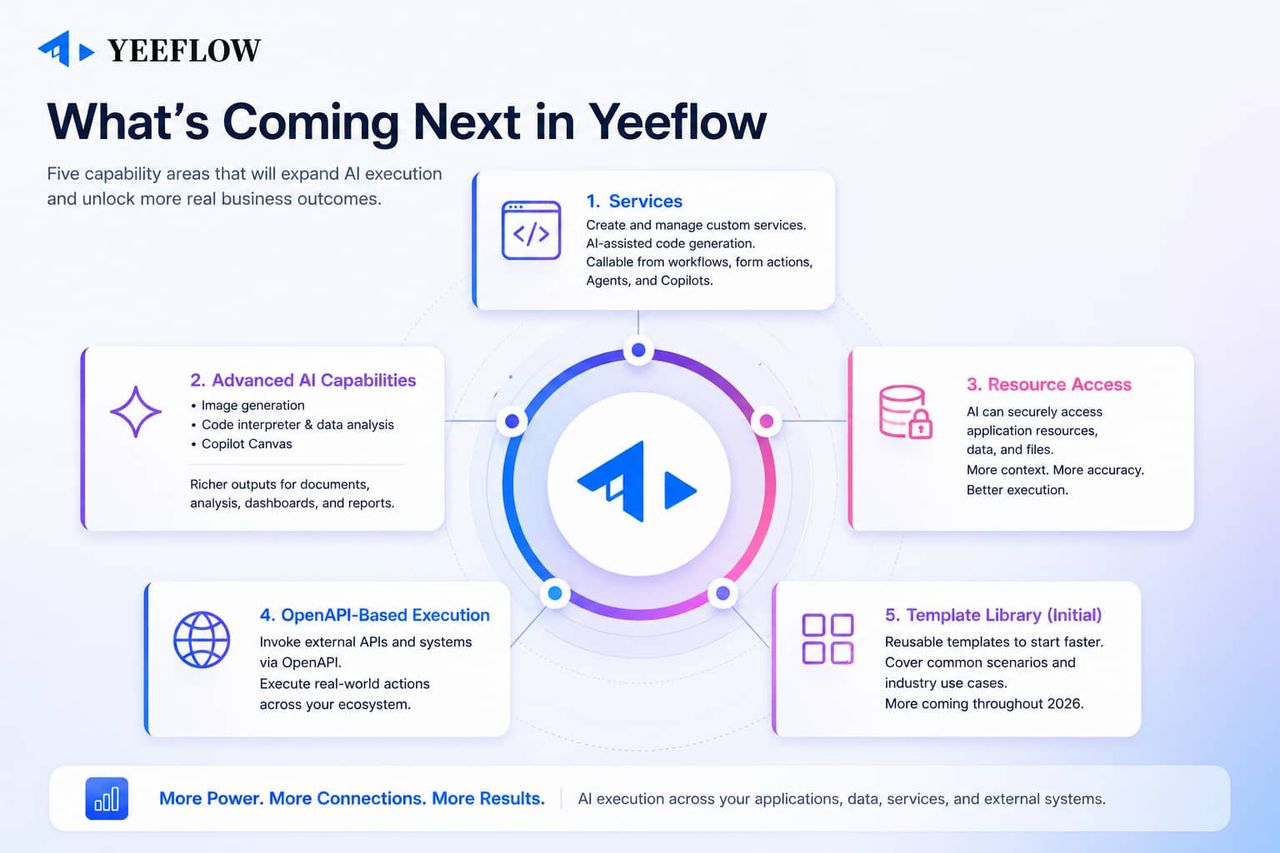
1. More execution power through Services
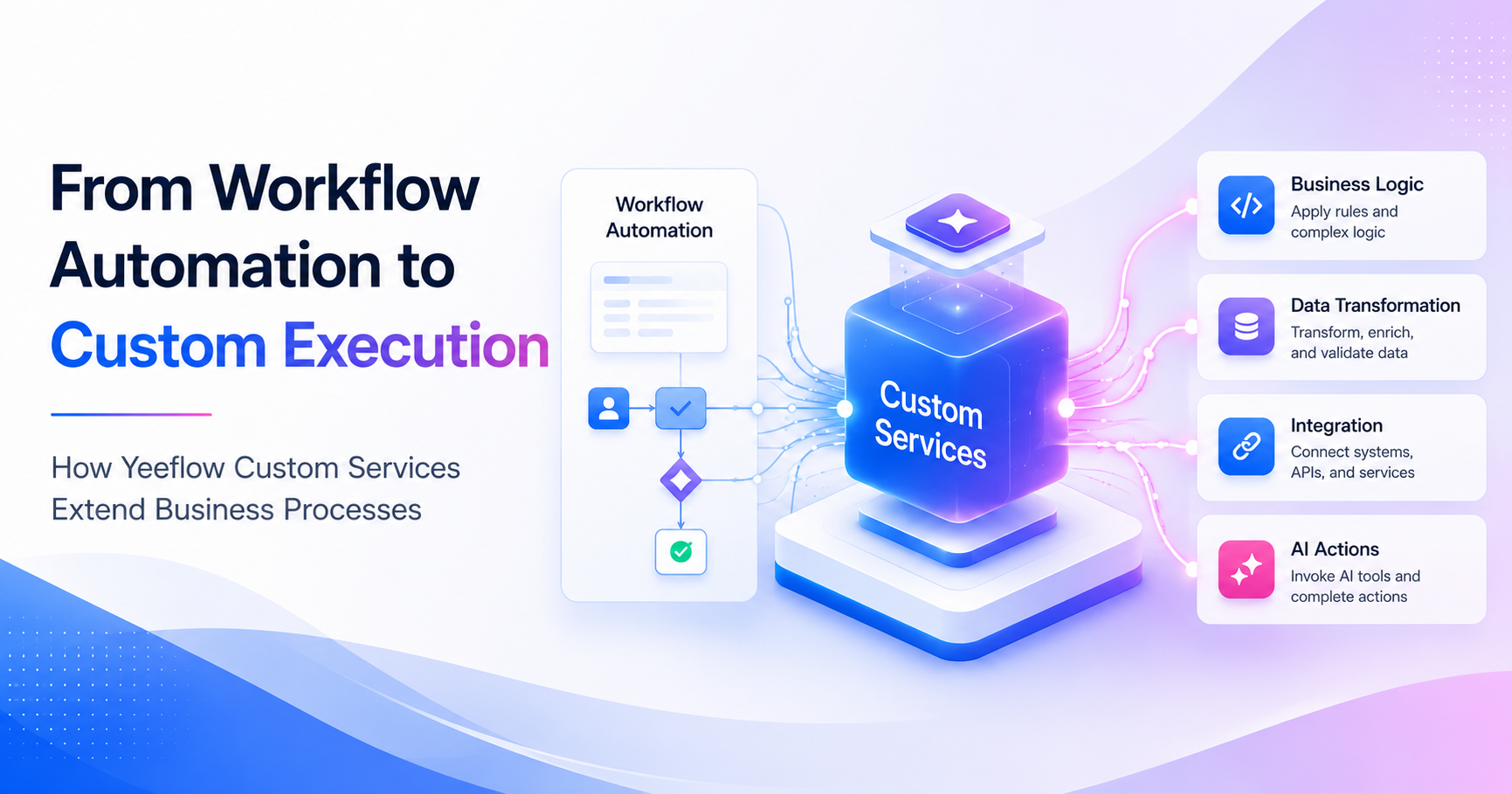
Services are a key next step because they create a programmable backend execution layer for Yeeflow.
In practical terms, this means organizations can move beyond visual configuration alone and start using reusable backend logic that can be called by workflows, form actions, AI Agents, and Copilots. The roadmap positions Services as a core Q2 Release A priority and also as part of AI Builder over time, where users can use AI to help generate backend service code.
This matters because AI execution becomes much more useful when it can work through structured backend capabilities instead of only UI-level actions.
2. Richer AI capabilities for real business outputs
The next step is also about improving what AI can produce, not just what it can say.
Q2 Release A includes advanced AI capability modules such as image generation, code interpreter and data analysis, and Canvas for Copilot output experiences. The roadmap frames these not as novelty features, but as capabilities for generating documents, analytical outputs, charts, dashboards, summary reports, and richer Copilot experiences.
That aligns with the strategy direction as well: advanced AI capabilities should support real business work and improve output quality inside applications and workflows.
3. AI access to real application resources
A major step in AI execution is giving AI safe access to the business resources that matter.
That is why the roadmap includes a resource access tool for Agent and Copilot. This is designed to allow admins to grant AI access and operational permissions on native Yeeflow resources such as approval forms, data lists, document libraries, reports, AI Agents, and other application components. It also introduces operational actions such as read, add, edit, trigger, and invoke.
This is foundational.
Because once AI can work with real application resources, it starts to move from assistant behavior toward operational participation.
4. More open API-based execution
Yeeflow has already taken important steps here. The April release expanded API connection support, OAuth-based integration, and AI interaction with external systems through the Call HTTP Request tool for Agent and Copilot. That helped AI move beyond conversation and begin interacting with third-party systems through configured APIs.
What comes next is a more structured and scalable version of that direction.
The roadmap now points toward REST API invocation with OpenAPI schema, allowing Agent and Copilot to work with configured APIs through exposed operations, contextual tool selection, secure connection settings, and governance hooks for external use.
That is important because enterprise AI becomes much more practical when API execution is not improvised one request at a time, but built on a clearer operational and permission model.
5. The first layer of reusable AI templates
Execution power also needs reuse.
Q2 Release A includes the first version of an initial template library for ready-to-use AI Agents and Copilots, with browsing, installation, metadata, and dependency validation. The roadmap makes clear that this is a foundational library release, not yet the final reusable solution marketplace.
This matters because AI value compounds faster when successful capabilities can be reused across apps, teams, and customers.
That reuse theme is deeply consistent with the broader 2026 strategy, which treats templates, Agents, Copilots, Services, and packaged solution assets as key levers for scale.
What this means for customers
For customers, the next step in Yeeflow AI execution is not about more AI for its own sake.
It is about more useful AI in real business environments.
That means:
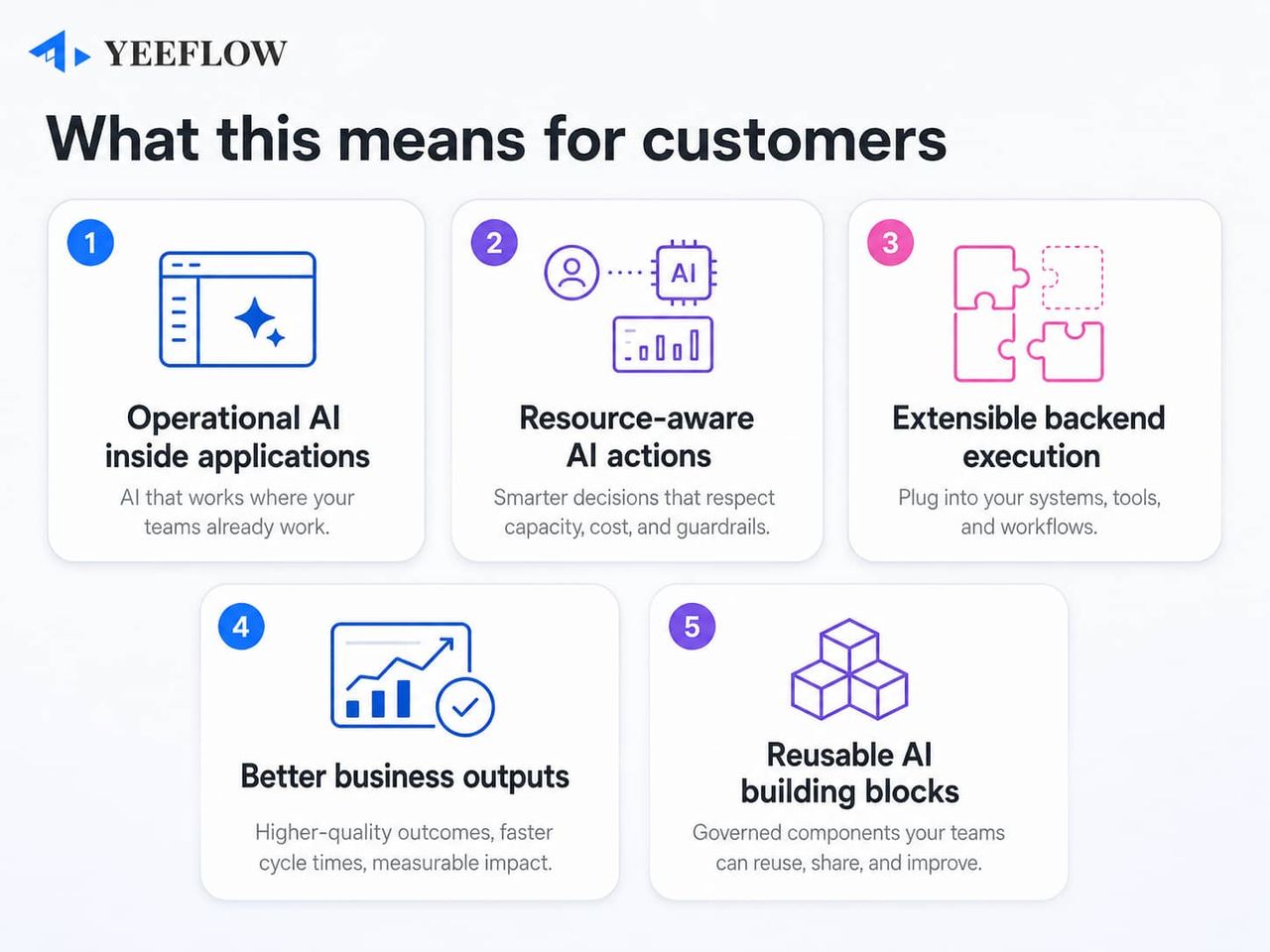
- more operational AI inside applications
- more structured AI interaction with resources
- more extensible backend execution
- more useful outputs for business work
- more reusable building blocks for scale
In other words, Yeeflow is moving closer to a model where AI can help organizations not only build faster, but also operate more effectively.
That is what makes the direction strategically important.
Because the real differentiator in enterprise AI will not be who can add the most AI features.
It will be who can connect AI to:
- real applications
- real workflows
- real business data
- real resource operations
- real service execution
- real system-to-system interaction
That is the space Yeeflow is moving into.
What Yeeflow is not claiming
It is also important to be clear about what this next step does not mean.
Yeeflow is not positioning AI Builder or AI execution as unrestricted autonomy. The roadmap and strategy are both explicit that Yeeflow should follow a practical maturity path: progressive capability first, then deeper governance, observability, testing, lifecycle control, and broader orchestration later in the year. AI Builder in particular is meant to remain practical and credible, not be positioned as full autonomous enterprise application generation in 2026.
That realism is important.
Because enterprise trust is built when product direction is both ambitious and believable.
The next step is becoming clearer
Yeeflow’s 2026 direction is not a collection of unrelated AI features.
It is a platform story.
A story where:
- builders create faster with AI
- users work more naturally with AI inside applications
- Agents and Copilots act across resources, services, and APIs
- the platform becomes more open, reusable, and extensible
- governance and control mature as capability expands
That is why this next phase matters.
It is not just about adding more AI capabilities.
It is about making Yeeflow stronger as an AI execution platform.
And that is the next step we are building toward.
Final thought
The future of enterprise AI will not be defined by chat alone.
It will be defined by whether AI can help move work forward — inside applications, across workflows, through services, and between systems.
That is what Yeeflow AI execution is really about.
And the next phase is almost here.