Overview
What this template helps teams build
Department: Marketing (with oversight from Compliance or Brand Management in some organizations).
Industries: Especially important in regulated industries (like Pharmaceutical, Finance, Insurance) where
marketing content must be compliant, and in large enterprises where brand consistency is critical. For
example, a pharma company must get legal approval on any advertisement for a drug, or a bank’s
marketing department needs compliance sign-off for campaign materials. Even in less regulated industries,
big companies often have formal approval for major campaigns or public content.
Purpose: To review and approve marketing initiatives or content pieces before they go live, ensuring they
meet brand guidelines, legal requirements, and strategic objectives. Yeeflow can be used to build an
12approval form for marketing campaigns, where a marketing manager submits the campaign plan or
content, and it is routed to the necessary stakeholders (like senior marketing execs, legal, compliance, or
external partners) for approval. This prevents costly mistakes such as publishing unapproved content, and it
documents the approval of marketing materials.
Workflow: A typical marketing campaign/content approval process might look like:
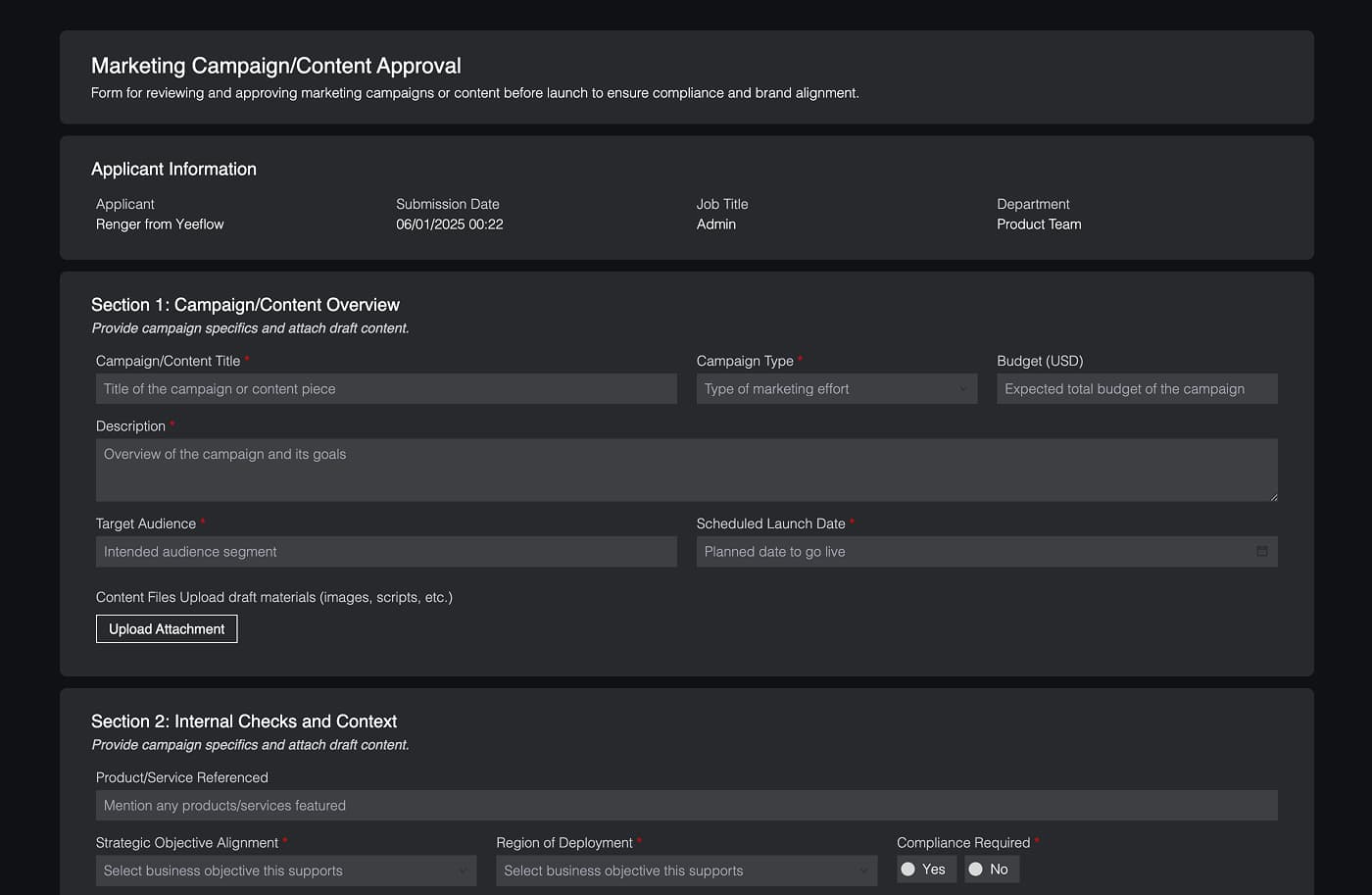
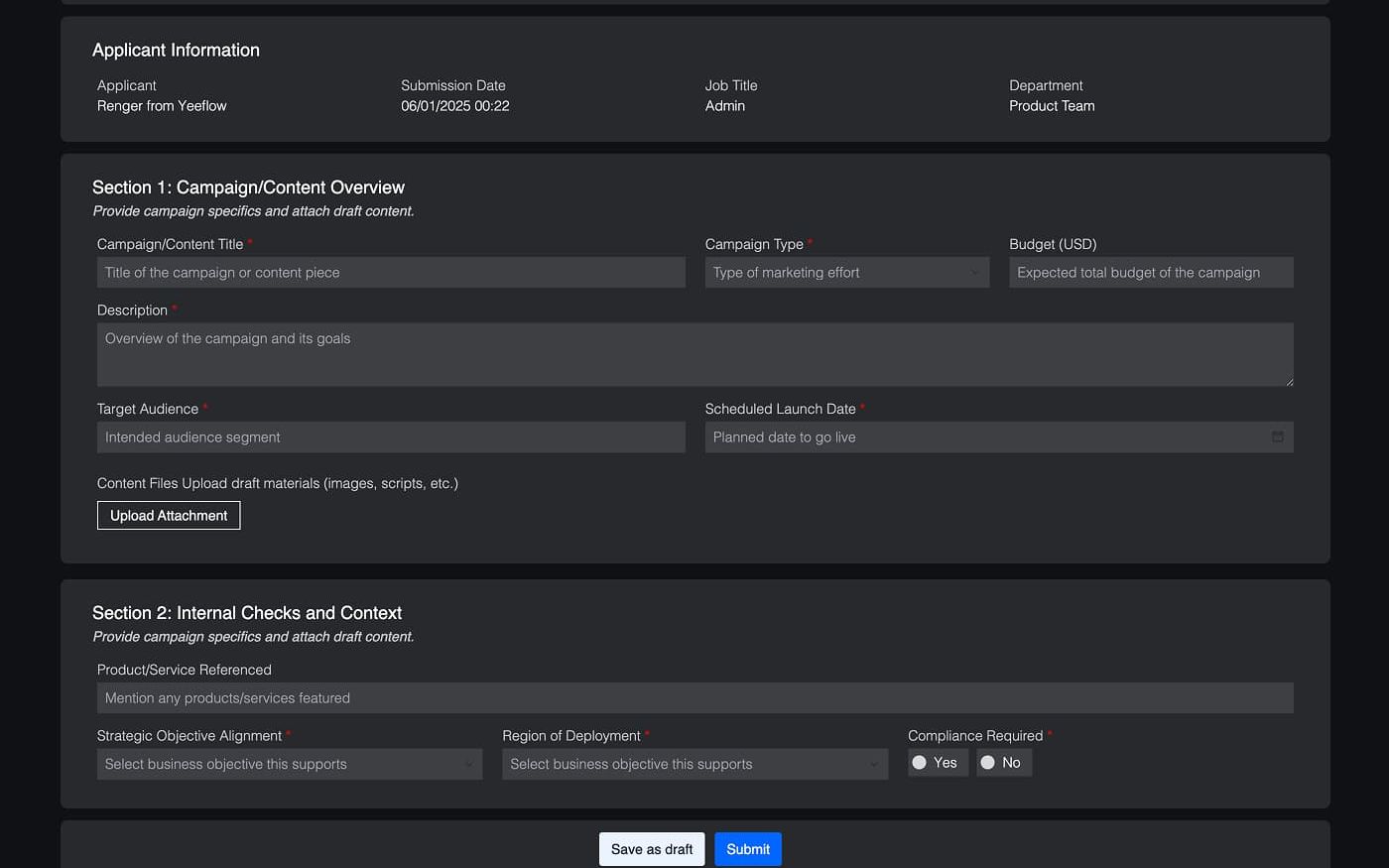
1. Campaign/Content Submission: A marketing team member initiates an approval request in Yeeflow.
Depending on the use case, they might attach creative content (images, copy, video scripts) or describe a
campaign (target audience, channels, budget). For content like a blog article or advertisement, the draft
content is attached. For campaigns, the form might include fields for budget, timeline, and objectives.
2. Manager Review: The first approval is usually internal to marketing – e.g., the Marketing Director or
Creative Director reviews the submission. They check that the content aligns with the marketing strategy
and brand voice. They might request edits (Yeeflow can allow them to reject with comments, which sends it
back to the creator for revision). Once satisfied, they approve it forward.
3. Cross-Functional Approvals: Next, the workflow can branch out to other stakeholders based on the
content type:
- Legal/Compliance Approval: For industries like finance or healthcare, a compliance officer or legal
counsel must review the content for regulatory compliance (ensuring no misleading claims, required
disclaimers are present, etc.). They approve if everything is compliant. If not, they mark changes needed
(e.g., “add risk disclosure on slide 3”).
- Product or Sales Approval: If the campaign involves specific product messaging or pricing, the product
manager or sales leader might review to ensure accuracy and that promises can be met by the product
team.
- Brand/Communications Approval: Some organizations have a brand council or communications team
that double-checks that the campaign adheres to corporate branding standards and messaging guidelines.
Yeeflow can route to all relevant approvers either in parallel (to save time) or in a specific order. It might go
to legal and brand concurrently, for example. Each approver gives their sign-off.
4. Executive Approval (if high-impact): For major campaigns (e.g., a nationwide ad campaign or very large
budget spend), a CMO or even CEO might be in the approval chain. Yeeflow allows conditional logic so that,
say, any campaign over \$X budget or anything using the CEO’s quote will require that executive’s approval
at the end.
5. Final Approval & Launch: Once all required parties have approved, the campaign/content is cleared for
launch. The Yeeflow workflow finishes, and the marketing team is automatically notified that they can
proceed to execute or publish the content. If any approver rejected or requested changes, the workflow
cycles back to the submitter to address the feedback, then routes again for approval – ensuring the final
version gets full sign-off.
6. Logging and Proof of Approval: Yeeflow keeps a record of all approvals which is especially important for
compliance. If down the line anyone questions if something was approved, the marketing team can pull up
the Yeeflow record showing, for example, that legal and compliance approved version 3 of the ad on a
certain date. This can protect the company in audits or in case of any public issue.
Example: A regional bank uses Yeeflow for approving all social media content and marketing campaigns.
The marketing specialist submits each upcoming social media post (with text and image) through a Yeeflow
form. It automatically goes to the Marketing Manager and the Compliance Officer. Once both approve, the
post is scheduled. If compliance finds an issue (say the wording promises a guaranteed return which isn’t
allowed), they reject with notes, and the specialist revises the text and resubmits. This process, facilitated by
Yeeflow, ensures every piece of external communication is vetted without significantly slowing down the
13team. In the past, the bank had a manual email-based process that was often chaotic; now Yeeflow provides
a clear sequence and record. Another example: at a pharmaceutical company, any marketing material
(brochures, ads) must be approved by medical legal review committees. Yeeflow’s form and workflow
enabled a smooth review by multiple experts in parallel, cutting approval times perhaps from months to
weeks. While specific customer names aren’t disclosed here, Yeeflow’s capability to route approvals across
departments lends itself perfectly to marketing compliance needs. The result is faster campaign launches
but with full assurance that necessary approvals (brand, legal, etc.) are in place before anything goes public.